Pages

Showing posts with label Bergoglio. Show all posts

Friday, July 16, 2021

UPDATED: Developments Already Re Guardians Of Tradition

Over at Fr. Z's blog we learn of an important point of canon law. Bishops--local ordinaries as they're termed--retain, even under a dictatorial Vatican occupant, considerable authority in disciplinary matters. And control over liturgical matters is disciplinary. That means that no bishop actually has to follow this directive:


Look… the bottom line is this.  There is sloppy language in this document that, frankly, if carefully read with the interpretive principle odiosa restringi et favores convenit ampliari, there isn’t that much that would have to change in a diocese – depending on the bishop. Sure the document is dreadful: it can be read in a severely restrictive way or be read in a lenient way. Just as that dreadful footnote in Amoris could be read one way or the other.

I would add to the above the provision of can. 87 –

Can. 87 §1. A diocesan bishop, whenever he judges that it contributes to their spiritual good, is able to dispense the faithful from universal and particular disciplinary laws issued for his territory or his subjects by the supreme authority of the Church. He is not able to dispense, however, from procedural or penal laws nor from those whose dispensation is specially reserved to the Apostolic See or some other authority.

...

So, a diocesan bishop can dispense from disciplinary laws, both universal laws and those particular laws made by the supreme ecclesiastical authority (read: Supreme Pontiff) for his territory and his subjects.  Since the provision that the Traditional Roman Rite ought not be celebrated in parish churches (cf. Traditionis Art. 3) is a disciplinary law, and has not been reserved to the Apostolic See, the diocesan bishop is free to dispense from that norm!


Fr. Z goes on to note toward the end of his post that already a number of American bishops have issued statements suggesting, in effect or even point blank, that nothing is going to change. Not in their dioceses. It's almost as if they were lining up to issue their statements.

What's going on?

The explanation may be found in the most recent post of a noted Italian Vatican watcher, Sandro Magister:


Conclave in View, Everyone Backing Away From Francis


Movers and shakers in the V2 are convinced, says Magister, that a conclave is going to happen sooner rather than later. It seems that a large swath of that world cordially detests Bergoglio. We're not talking about raging idealists here--they're simply fed up with his dictatorial ways and noxious personality, with the hangers on that surround him. They also want their own shot at power and influence. Really!
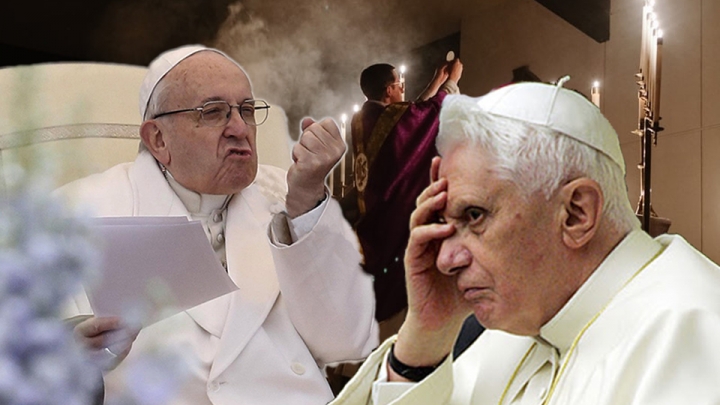


As a result, having raised their fingers to the prevailing breezes, even the far Left wing of the V2--which is pretty far Left--have figured out that their chances of planting their backsides in the chair of Peter, or influencing the selection, may depend on distancing themselves from all things Bergoglio.

How far that distancing could go is suggested by a recent article in a French liturgical magazine, Paix liturgique. The article was written toward the end of June, and dealt with the rumors of an abrogation of the traditional Roman-Gregorian liturgy:


THE ENEMIES OF SUMMORUM PONTIFICUM WANT WAR


I translated the article for family, and the really relevant portion is this paragraph:


Andrea Riccardi, main character of the Community of Sant'Egidio, who is the complete opposite of a conservative, in a recent book, where he considers the fire of Notre-Dame de Paris as a parable, deals with the announced social disappearance of the Church: La Chiesa brucia. Crisis e futuro del cristianesimo (Tempi nuovi, 2021), The Church is on fire. Crisis and future of ChristianityHe analyzes, country by country, in Europe, the collapse of Catholicism. In the conclusion, of course, he expresses an obligatory hope on the theme "crisis is not decline", but he had already let fly many telling one liners"many Catholics have gone from enthusiasm for Bergoglio to disillusion", "the solution will not come from reform". And then also this observation: "Traditionalism is a reality of some importance in the Church, both organizationally and in terms of resources" [lit. "in the organization as well as in the means"].


In other words, even the enemies of tradition--at least the more realistic among them--recognize that tradition cannot be simply kicked to the side of the road, as Bergoglio and his henchman have attempted to do. That reality may be exactly what some American bishops--who have undoubtedly had time to consider their response--are taking into account. In the post Bergoglio era to get ahead may require a degree of ideological flexibility, a coming to terms with a reality that has "some importance ... both organizationally and in terms of resources."

Let's face it--most bishops have plenty of problems and headaches without adding a pissing contest with the least troublesome and most generous portion of their flock. Many who are not committed ideologues may calculate: this guy is a short timer, so why should I cause myself more trouble than I need to? Those with ambitions may also recognize that a display of flexibility is in their self interest. Thus, Peter Kwaƛniewski writes (Traditionis Custodes: The New Atom Bomb):


I believe at least some bishops will be non-plussed by how cold, harsh, and foolish is Francis’s anti-TLM motu proprio, which has all the charm of a decree by Stalin ordering the purge of Ukrainian dissidents. Of course, there are others who will run with it, but I can’t imagine that bishops who have seen the many good fruits of Summorum Pontificum—not least, the steady and often generous financial contributions that flow in from traditional groups—and who enjoy good relationships with priests and parishes that peacefully celebrate the TLM will want to disturb them for the sake of falling in line with a temporary tyrant. Any bishop who genuinely loves the Catholic Faith, any bishop aware of the burgeoning love of tradition among the young and its power to revitalize the Church after the doldrums (not to say freefall) of recent decades, will quietly set aside this painful document and proceed as if nothing has changed—or rather, proceed in the certain knowledge that, as Rorate Caeli tweeted, “Francis will die and the traditional Mass will live on.”

On the pragmatic side, most bishops do not have a superabundance of clergy such that they could afford to alienate a sizeable number of their presbyterate. If enough priests in the more conservative dioceses stick to the Latin Masses to which they have an inalienable and unabrogatable right, what are the bishops going to do — throw them all out? Where will they get pastors? Where will they get future vocations? Do bishops need another huge headache on their hands, a civil war, a smouldering discontent that saps time and energy on all sides? Benedict XVI brokered a fragile peace, one under which a certain measure of non-polemical normalcy was possible. Many will want to keep that peace, such as it is, in preference to renewed hostilities.


Interesting times.

ADDENDUM: Fr. Z's site includes an advertisement for coffee:



I can personally vouch for this coffee--it's pretty good. At least the two varieties I recently tried with a gift certificate are. I like dark roasts:

Hermits Bold Blend

Midnight Vigils Blend

UPDATE: I liked this from one wag:


Quis custodiet traditionis custodes?


UPDATED: Guardians Of Tradition

Writing here may be a bit slow today--I have a lot to catch up on and there may be additional fallout from yesterday's developments. 

However, it's necessary to offer some comment on the Vatican's renewed effort to suppress the traditional liturgy--popularly known as "the Latin Mass", more popularly termed something like the Roman-Gregorian liturgy. That's because it was Gregory I "the Great" (c. 540 – 12 March 604) who codified the traditional liturgy of Rome. The first attempt to suppress this traditional liturgy--which can be traced back to Apostolic Tradition--occurred nearly 1400 years later in 1970--with very mixed results. Perhaps this latest and renewed effort at suppression of Christian worship means that the V2 was emboldened by the passive reception by catholics of Pachamama worship in the Vatican. Whatever. Bergoglio has issued the ironically titled motu propriu in our subject line, Traditionis custodes, with the obvious intent of suppressing the Roman liturgy of ages.

This event has implications in connection with the planned Great Reset--Bergoglio obviously hopes to transform the V2 into the 'spiritual' vehicle of the globalist Great Reset--a Neo-gnostic religion. We touched on this yesterday at the end of Class, Influence, Power by citing Maureen Mullarkey's Inside The Vatican’s Surprising Alliance With Biotech Venture Capital, which I highly recommend in its entirety. Nothing that we see happening around us is happening is some sort of a vacuum. It's all connected. The Power Elite really does have global ambitions, both literally and figuratively.

Tuesday, June 29, 2021

UPDATED: Tradition And Strawmen

George Bergoglio--he's the guy who lives in Rome and dresses in white--has been on a toot lately attacking "rigidity" and "tradition"--as he sees it. For example, as reported by LIfeSite, in his homily for the feast of Saints Peter and Paul, he appeared to compare ‘rigid’ Catholics to St. Paul’s persecution of the Church:


The Apostle Paul also experienced the freedom brought by Christ. He was set free from the most oppressive form of slavery, which is slavery to self. ... He was also set free from the religious fervour that had made him a zealous defender of his ancestral traditions and a cruel persecutor of Christians. Set free. Formal religious observance and the intransigent defence of tradition, rather than making him open to the love of God and of his brothers and sisters, had hardened him: he was a fundamentalist.


Those who have read Paul's letters and the account of his ministry in the Acts of the Apostles might be forgiven if they don't recognize this portrait of the apostle. Indeed, such persons might find in this dichotomy of tradition and freedom in Christ a straw man that Paul himself would have rejected. For Paul, it is precisely adherence to what was handed down--the tradition of the Apostles--that sets us free. Such subtleties are apparently lost on Bergoglio.

However, LifeSite notes:

Monday, February 11, 2019

Convergences

A remark I made following the most recent blog post,

What's needed is what amounts to a spiritual makeover of "the American people," one that would allow for a principled remake of the country. 

sparked two comments from differing yet converging perspectives.

Commenter Joe addressed this remark from a specifically Catholic perspective and related it to the upsurge of abortion extremism in the US. Obviously this relates, as well, to politics in the Trump era. Trump's strong support of pro-life policies, including in his judicial appointments, is well known. Further, he is well known to listen closely to the advice of a devout Catholic, Kellyanne Conway--who was also the primary writer of Trump's wildly successful and outspokenly pro-life SOTU address. Joe goes so far as to tentatively relate some of what we're seeing in our public life to possible "End Times" signs. Rod Dreher addresses those darker concerns in light of recent events in a riveting blog: The Age Of Antichrist.

On the other hand, commenter Steven Fine wrote from a specifically Jewish perspective, drawing attention to "Catholic concern over Islamization and other issues as expressed by William Kilpatrick" at Crisis Magazine. The relation of these Catholic concerns (Islamization, abortion, gender politics, etc.) to the politics of both the Trump presidency and the West in general is clear enough. However, Steve also draws attention to the circumstances surrounding the resignation of Benedict XVI (as was, Joseph Ratzinger as is) and his replacement by Jorge Bergoglio, currently known as Francis I (I won't get into the fraught controversies over these events). It's not hard to see that Steve relates Bergoglio's policies regarding immigration as playing very much into "Islamization," both in Europe and in the US. That conservative Jews should share those Catholic concerns is not new. However, coming as they do at a time of the Vatican II Church's growing embrace of Islam, in tandem with the increasingly overt anti-Semitism of the Left--with which the Catholic bishops typically align--must be troubling. Bergoglio's own well known and close ties to Soros operatives can only add to that sense of alarm.

So, the convergence I see in these two commenters is the recognition and concern that the Catholic Church--arguably the central institution of the Western world--should be playing a conservative role (in the broad sense of preserving the cultural principles of the West) but is instead abandoning that traditional role. The moral and spiritual leadership that not only Catholics but also non-Catholics have come to rely upon--in the moral, spiritual, and intellectual arenas--is degenerating into a modernist style Babel and withdrawal from any claims to leadership.

That appearance of collapse was only strengthened last week when Bergoglio traveled to the Dar-al-Islam--the House of Islam, Abu Dhabi--to formally renounce the Catholic faith in favor of a type of Neo-Gnostic syncretism, claiming: “The pluralism and the diversity of religions, ... are willed by God in His wisdom.” The symbolism of the event could not have been starker, and it should be raising alarms among all those--Catholic and non-Catholic alike--who share a concern for not merely the health but the very survival of Western civilization.

Wednesday, September 5, 2018

UPDATED: Bergoglio and the Press

Since the release of the Pennsylvania Grand Jury report regarding sexual abuse by Roman Catholic clergy the Catholic world has been in turmoil. That turmoil only intensified--exponentially--when retired Archbishop Carlo Maria ViganĂČ released what amounted to an affidavit accusing senior Catholic hierarchs of knowingly covering up and even enabling the abuse. ViganĂČ's focused special focus was on the retired Cardinal Archbishop of Washington, DC, Theodore McCarrick: a prelate of vast influence in the American church, a reputed "kingmaker," one man fund raising juggernaut, close adviser to Pope Francis, and mentor to such progressive luminaries as cardinals Wuerl, Cupich, and Tobin--all among Francis' anointed. As if that weren't enough, ViganĂČ called on Francis himself to resign for his knowing complicity in the coverup of McCarrick's crimes.

ViganĂČ's release of his testimony was timed to coincide for maximum effect with Francis's controversial trip to Dublin--already a public relations disaster due to lack of attendance. That disaster was compounded when Francis issued his non-denial statement in response to press questions about the ViganĂČ testimony: "I will not say a single word ..." followed by a tacit appeal to the press to basically ignore it all.

Ordinarily that type of stonewalling by a super high profile public figure would be met with a storm of protest and accusation in the media. Just such a storm did in fact ensue, but mainly in the world of Catholic blogging and tweeting. The mainstream media, on the other hand, seemed strangely (or maybe not) indifferent.

Where to begin? In the past Catholic sex scandals involving the clergy have been widely characterized as pedophilia. Knowledge that this characterization was, in fact, inaccurate, that the problem was overwhelmingly one of homosexual priests preying upon adolescents and young men, had been carefully kept in the background. With this fresh outbreak of scandal, however, the Catholic blogosphere, fueled by ViganĂČ's testimony regarding McCarrick's abuse of seminarians, quickly galvanized around the accusation of a powerful "lavender mafia" of homosexual prelates dominating the post Vatican II Church.

Thursday, April 26, 2018

Antonio Livi: There Is A Disturbing Continuity Between Ratzinger And Bergoglio

In January, 2018, I wrote a series of posts on the theme of the philosophical continuity between Ratzinger and Bergoglio, beginning with a translation of a review essay by Professor Antonio Livi. Livi is a former dean and professor of philosophy at the Lateran University in Rome, and was formerly incardinated in Opus Dei. The title of that essay, "Heresy is in Power," expresses a continuing theme in Livi's commentary on the current crisis in the Church. That essay lays much of the blame for the hegemony of Modernist thought in the Church at the feet of Ratzinger, and of Ratzinger's own philosophical errors.

Today Gloria TV published a transcript of a recent interview with Livi in which Livi stated that Bergoglio "was elected to carry out a reform [of the Church] in the Lutheran sense”.  He also flatly stated that:

Francis’ election was a big set-up which will eventually lead to the recognition of Luther and to the creation of a Mass without consecration. According to Livi this revolution was already planned in the early sixties. The last fifty years were marked by the activity of “evil and heretical” theologians in order to conquer power. “Now they have conquered it.”

I also wrote a pair of posts on this same theme--the continuity between Ratzinger and Bergoglio--in March, 2018, stemming from the controversy over Ratzinger's letter that offered a theological endorsement of Bergoglio:

Bergoglio's LetterGate--Continuity and Discontinuity
A Case Study On Continuity Between Ratzinger and Bergoglio: The Spirit And "Living Tradition"

What follows is a brief interview with Livi that appeared in Italian, and which I've translated. In the interview he touches on the same theme of continuity described above, in an enlightening way--including a brief reference to the resistance that otherwise intelligent and honorable people raise to what is "an undeniable theological fact". I will simply add, with regard to Livi's claim that "Today they [Modernists] are in charge of practically all the Vatican dicasteries ", that assuming that Livi is correct in his assessment of Ratzinger's thought--and he is--then this should come as no surprise. Most of the episcopal heroes of the Neo-Catholics of the V2 Church--men such Chaput, Burke, and Pell, have long proclaimed their adherence to Ratzinger's way of thinking. The simple fact is that WojtyƂa and Ratzinger largely paved the way for Bergoglio and his German masters.


Monsignor Livi: "In the Church, heresy is in power and ignorance has been canonized"


For the fifth anniversary of the pontificate of Pope Francis, Monsignor Dario Edoardo ViganĂČ, responsible for Vatican communication and Vatican News, revealed a letter from Pope Emeritus Benedict XVI addressed to Pope Francis. We interviewed Monsignor Antonio Livi on this matter.
Professor Livi, does this endorsement [of Francis] by the Pope Emeritus surprise you?
"No. In the end, his letter, even if it does not touch doctrinal issues, proves that I've been right in always maintaining that there is a disturbing continuity between Ratzinger and Bergoglio in the way of exercising the ecclesiastical magisterium. Many (and among them a very esteemed friend, Antonio Socci) do not want to admit it. But from a theological point of view it's an undeniable fact, even if this observation does not imply a critique of Benedict XVI from the point of view of personal sanctity ".
Because?
"Because even previous Popes, including those who are already canonized (like John XXIII and John Paul II) or will soon be (like Paul VI), have not prevented the growing [progressiva] hegemony of neo-modernist theology in the Church. I am presenting a very significant book throughout Italy: "A bishop writes to the Holy See on the pastoral dangers of dogmatic relativism" (Leonardo da Vinci, Rome 2017) [The letters are selected and annotated by Livi.]. These are the letters that Monsignor Mario Oliveri, when he was bishop of Albenga, wrote to Pope John Paul II and to Benedict XVI to implore them to curb the invasion of neomodernistic ideas and praxis in the Church: but bishop Oliveri received no positive response from these Popes. The result is (as I always repeat) that today we have "heresy in power" in the ecclesiastical structures for teaching theology and pastoral government. I'm not surprised by this statement by Ratzinger about the common doctrinal criterion that inspired his pontificate yesterday and today inspires the pontificate of Pope Francis: because Bergoglio and Ratzinger present two faces of the same coin. The German is the cultured and professorial Pastor, the Argentine the populist and demagogue, in search of consensus with the exponents of secular culture ".
Why do you say these things about Ratzinger?
"I know him well, I respect him and venerate him as a man of God. When I had him read (in 2012) the first edition of my treatise on "True and false theology ", he replied in writing praising my work. But he certainly did not share my severe judgment on the false pro-Lutheran Catholic theology, which is opposed to the immutability of dogma and its metaphysical conceptualization, and was accepted by the ecclesiastical magisterium on the basis of Thomist theology and the scholastic tradition. Ratzinger the theologian prefers personalist, existential and dialectical theology: after all, he belongs to the theological progressivism of his friend Karl Rahner. As Prefect of the Congregation for the Doctrine of the Faith, Cardinal Ratzinger often let heresy slide, or at least tolerated it. Maybe it also depends on his delicacy of mind and his meekness. However, it isn't possible to be good theologians and above all good pastors if you don't protect dogma from heresy (and the worst heresy is to say that faith does not need dogmas). He, Ratzinger, is inclined to the relativistic, historicist (according to the hermeneutical school) interpretation of absolute fidelity to dogma ".
He probably wrote those things in defense of the unity of the Church, sensing the danger of a schism ...
"I don't believe it. A substantial schism is already underway. If he really believed in dogma and intended to free the Church from heresy, he did not have to resign or could subsequently disapprove the theses of Pope Francis. I have the feeling that it's skillful role playing. Francis is the demagogue, Ratzinger the cautious one ".
And the Church?
"It's in trouble. It's a result of the seizure of power by modernist theologians, first under the pontificate of John XXIII and later with Vatican II. Today they are in charge of practically all the Vatican dicasteries ".
On TV and in most of the media, to commemorate the five years of the pontificate of Francis, no critical voices were heard or at least they were not asked ...
"It shows that heresy is in power. And we have also canonized ignorance ".

Wednesday, March 28, 2018

Is Cardinal Dolan Signalling a Sea Change in the American Catholic Church?

Last Thursday Cardinal Timothy Dolan of New York penned an essay in the WSJ. The title of the essay, and it's subtitle, tells you pretty much all you need to know if you don't subscribe: The Democrats Abandon Catholics: If you value religious education or life’s sanctity, you’re not welcome in the party.

This is a far more political statement, in an overtly partisan way, than we're used to seeing from the US Catholic bishops. It also has broader implications for the Church generally and for politics generally, so what's going on here?

For starters it's helpful to ask: Who would have been pleased by this essay, and who would have been, well, let's say, displeased?

Let's see--displeased? The Democrat Party--that's a no brainer. They just lost a presidential election because they lost the heavily Catholic Reagan Democrats in the Midwest. This won't help--not in 2018, not in 2020.

How about the Bergoglio Vatican? Displeased? You'd better believe it. It's a given that Bergoglio personally has no use for the USA, and all you have to do to remind yourself just how virulent that dislike is, is reprise the article by Antonio Spadaro, the Jesuit editor of La CiviltĂ  Cattolica, a journal that is reported to be personally vetted by Bergoglio himself. The article is titled Evangelical Fundamentalism and Catholic Integralism: A Surprising Ecumenism, and you can find an analysis of it by Sam Gregg here. The long and the short of it is that Spadaro--and presumably Bergoglio--are disturbed by the ecumenical cooperation between Catholics and Evangelicals. Why? Because they fear the rise of a "theocracy." Here's how Gregg puts it:

Friday, March 23, 2018

A Case Study On Continuity Between Ratzinger and Bergoglio: The Spirit And "Living Tradition"

Back on March 17, 2018, Fr Hunwicke pointed out in his blog post Heureka! Heureka! that

"The first and fontal dogma there attributed [in Wikipedia] to 'Modern Church' [i.e., Modernism] is ... lo and behold ... the prime distinctive dogma of Bergoglianism:
"DIVINE REVELATION HAS NOT COME TO AN END"!!! 

What Fr Hunwicke is referring to is Bergoglio's constant contention that the Holy Spirit is speaking to him and that he is only doing what the Spirit bids him to do. The "God of surprises" communicates His surprises to Bergoglio through the Spirit. And we all know that whoever sins against the Spirit commits the unforegiveable sin. (Mark 3:28-29)

Fr Hunwicke appeared to believe that this notion, that revelation has not come to an end--which I refer to as "continuing revelation"--is a dogma that is distinctive of "Bergoglianism." In the comments I sought to rectify that misconception. It certainly is a distinctive mark of Bergoglianism, but it's just as certainly not unique to Bergoglianism. What, to me, makes this question a matter of some topical interest is that within a few days of Fr Hunwicke's post the whole question of an "inner continuity" between the pontificates of Ratzinger and Bergoglio took on added significance due to the famous letter of Ratzinger. In the letter Ratzinger responded to what amounted to a request that he endorse Bergoglio's ideas, as described in "eleven small volumes" by a variety of pro-Bergoglio theologians. I wrote about that controversy in Bergoglio's LetterGate--Continuity and Discontinuity, my central contention being that Ratzinger was quite correct in pointing out the "inner continuity" between his pontificate and that of Bergoglio. This fact of substantial theological agreement is, of course, exactly what Ratzinger cultists are in a complete state of denial about. To admit it would bring their entire worldview crashing down on their heads.

At any rate, wishing to bring some clarity to the matter, I commented on Fr Hunwicke's blog:

But, speaking of "continuing revelation," that, of course, is a position that Ratzinger was accused of holding as far back as his seminary days and right through his Dei Verbum days up to the present. A point of "inner continuity" with Bergoglio? [Dei Verbum, the Word of God, is the Dogmatic Constitution on Revelation, at Vatican II.]

Sunday, March 18, 2018

UPDATED: Bergoglio's LetterGate--Continuity and Discontinuity


For the past week the world of the Vatican II Church, and especially that corner of it occupied by Ratzinger/Benedict cultists, has been consumed with the Ratzinger letter fiasco. Let's get the obvious out of the way right up front: the affair was a tawdry attempt by Bergoglio to trade on the continued popularity of Ratzinger among "conservative" Vatican II adherents, who place their hopes for the Church on Ratzinger's "hermeneutic of continuity." The clear intent was to influence those who invoke Ratzinger to justify their opposition to Bergoglio to drop their opposition. The Bergoglian scheme backfired in spectacular fashion amid an explosion of conspiratorial speculation, most of it suggesting that by use of secret decoder rings or other devices the letter can be seen to diss Francis' thought and his policy. (For thorough coverage of the controversy, a good source is Sandro Magister's blog.)

There is both more and less than meets the eye in most of this speculation. The implicit assumption behind most of it is that Ratzinger engaged in some sort of preturnaturally clever passive-aggressive ploy against Bergoglio and his communications team. The truth is that Ratzinger's letter is clearly carefully written, carefully worded, and therefore should be taken at face value. It is polite and fair as well as honest throughout. The reason this assessment is so widely resisted is obvious: those who blame all the Church's troubles on Bergoglio will resort to virtually any rationalization to avoid accepting that Ratzinger really is in fundamental "philosophical and theological" agreement with Bergoglio--that the two pontificates share an "inner continuity"--as the letter affirms. To admit this continuity would be to expose the whole Ratzinger-as-bulwark-of-orthodoxy construct as a baseless fantasy. And yet, when this continuity is accepted, the observer is free to consider the rest of the letter with an open mind, and the benefit of doing so is that the letter also gives a clear hint in the direction of the discontinuity that actually does exist between the two pontificates. This understanding will open broad vistas on the mortal danger facing the Church.

Friday, February 23, 2018

John Lamont: The Bergoglian Assault on the Faith

I've just finished reading John Lamont's lengthy essay at Rorate Coeli: "The Meaning of Amoris Laetitia According to Pope Francis." This essay, in my view, has a direct bearing on an issue raised by Fr Hunwicke's recent blog post Sedevacantism. In that post Fr Hunwicke posed the question:

"Suppose a pope were, additionally, to require of every Catholic explicit assent ex animo to heresy as a necessary condition for Communion with himself, what would be the situation?"

Lamont's essay is important because it 1) sets out the principles of how we must proceed in judging situations such as the current crisis in the Church, and 2) he follows through and draws conclusions, as well as pointing out what steps need to be taken--but have not been taken.

Tuesday, January 16, 2018

This is Bergoglio's Game

How many times have you heard people say things like: "Bergoglio is really very traditional--he talks about the devil all the time?"

Today at Catholic World Report you can read in an article about reform of the Roman Curia--yes, a joke topic if ever there was one--the following:

[Bergoglio's] constant recommendation to pastors, that they foster and encourage popular piety and private devotion among the faithful, is water in the desert.

OK, so what's "popular piety and private devotion"? For the sake of argument, let's say that a major form would be Marian piety and especially, saying the rosary. That seems to be what the author has in mind, since he cites Bergoglio's "personal simplicity and deep devotion to Our Lady."

Question: Does "deep devotion to Our Lady" preclude a determination to utterly sweep away every vestige of an objective moral order? It would seem not, based on Bergoglio's own example. After all, Amoris Laetitia to one side, we've all seen his interviews with the atheist journalist Eugenio Scalfari, Bergoglio's chosen mouthpiece to the world. In them we can read such nuggets as this:

Friday, January 5, 2018

UPDATED: Bergoglio And Ratzinger: Two Peas In A Pod?

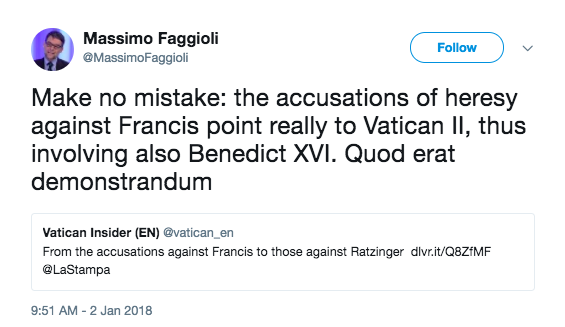
So, on January 2, "theologian" and internet gadfly Massimo Faggioli (aka "Maximum Beans) presented what appears to be the new Bergoglian talking point: an attack on Bergoglio is ipso facto an attack on Ratzinger--darling of Vatican II "conservative" Catholics. And an attack on Ratzinger is, ipso facto, an attack on Vatican II itself, since Ratzinger was one of the Modernist clique that led and directed the Council to their desired end. So, lay off Bergoglio unless you want to jeopardize the entire Ratzingerean legacy or--God forbid!--position yourselves on the "the wrong side of history":


This "narrative" that Faggioli deprecates is, of course, exactly that of Antonio Livi, the Italian philosopher whose book review, L'eresia al potere (Heresy In Power), we translated and examined a couple of days ago. Livi, reviewing the new book by Enrico Maria Radaelli, Al cuore di Ratzinger. Al cuore del mondo (At the heart of Ratzinger, at the heart of the world), makes the irrefutable--because so obvious--case that Ratzinger, far from being "a providential bulwark against what he himself called the dictatorship of relativism," was (with Wojtyla) in effect a Great Enabler of Modernism in the Church in the decades that followed Vatican and throughout his own papacy:

Wednesday, October 4, 2017

UPDATE: Opus Dei's Pope

Within the past week the Italian website InfoVaticana published an interview with Mariano Fazio, the Vicar General of Opus Dei--which is to say, the #2 guy at Opus Dei. Fazio took the occasion to harshly criticize the members of Opus Dei who have signed the recent Filial Correction. That would include Dr. Gerard J. M. van den Aardweg, although only Ettore Gotti Tedeschi, former president of the Institute of Works for Religion (IOR, the Vatican Bank), was mentioned by name. With regard to the Filial Correction, Fazio set forth this blanket position--one which would condemn any number of saints of the past: 

"Any faithful, bishop, cardinal, lay person has the right to tell the pope what he sees fit for the good of the Church, but it seems to me that he has no right to do so publicly and to scandalize the whole Church with these manifestations of disunity."

Fazio specifically included Gotti Tedeschi--as well as all the other signatories:

"I think he was wrong, too, like the others who signed."

Fazio even put forth the tired argument that Bergoglio hasn't actually changed any doctrine--as if Bergoglio's Cultural Marxist tactics somehow immunize him from criticism for the predictable results. "Feed my lambs," and if the lambs are fed poison, well, they're still being fed, right? No one, according to Fazio, would have a right to criticize the shepherd publicly.

This is, I think, a significant development. Opus Dei has taken an "under the radar" approach to Bergoglio from the very beginning--even allowing an Opus Dei member, Greg Burke, to serve as Bergoglio's spokesman. The Three Monkey approach. But of course, this under the radar approach is insufficient for Modernist revolutionaries in the long run. For Modernist revolutionaries push always comes to shove and the question posed in the old union song becomes theirs: Which side are you on?