Pages

Showing posts with label Ratzinger. Show all posts

Monday, February 11, 2019

Convergences

A remark I made following the most recent blog post,

What's needed is what amounts to a spiritual makeover of "the American people," one that would allow for a principled remake of the country. 

sparked two comments from differing yet converging perspectives.

Commenter Joe addressed this remark from a specifically Catholic perspective and related it to the upsurge of abortion extremism in the US. Obviously this relates, as well, to politics in the Trump era. Trump's strong support of pro-life policies, including in his judicial appointments, is well known. Further, he is well known to listen closely to the advice of a devout Catholic, Kellyanne Conway--who was also the primary writer of Trump's wildly successful and outspokenly pro-life SOTU address. Joe goes so far as to tentatively relate some of what we're seeing in our public life to possible "End Times" signs. Rod Dreher addresses those darker concerns in light of recent events in a riveting blog: The Age Of Antichrist.

On the other hand, commenter Steven Fine wrote from a specifically Jewish perspective, drawing attention to "Catholic concern over Islamization and other issues as expressed by William Kilpatrick" at Crisis Magazine. The relation of these Catholic concerns (Islamization, abortion, gender politics, etc.) to the politics of both the Trump presidency and the West in general is clear enough. However, Steve also draws attention to the circumstances surrounding the resignation of Benedict XVI (as was, Joseph Ratzinger as is) and his replacement by Jorge Bergoglio, currently known as Francis I (I won't get into the fraught controversies over these events). It's not hard to see that Steve relates Bergoglio's policies regarding immigration as playing very much into "Islamization," both in Europe and in the US. That conservative Jews should share those Catholic concerns is not new. However, coming as they do at a time of the Vatican II Church's growing embrace of Islam, in tandem with the increasingly overt anti-Semitism of the Left--with which the Catholic bishops typically align--must be troubling. Bergoglio's own well known and close ties to Soros operatives can only add to that sense of alarm.

So, the convergence I see in these two commenters is the recognition and concern that the Catholic Church--arguably the central institution of the Western world--should be playing a conservative role (in the broad sense of preserving the cultural principles of the West) but is instead abandoning that traditional role. The moral and spiritual leadership that not only Catholics but also non-Catholics have come to rely upon--in the moral, spiritual, and intellectual arenas--is degenerating into a modernist style Babel and withdrawal from any claims to leadership.

That appearance of collapse was only strengthened last week when Bergoglio traveled to the Dar-al-Islam--the House of Islam, Abu Dhabi--to formally renounce the Catholic faith in favor of a type of Neo-Gnostic syncretism, claiming: “The pluralism and the diversity of religions, ... are willed by God in His wisdom.” The symbolism of the event could not have been starker, and it should be raising alarms among all those--Catholic and non-Catholic alike--who share a concern for not merely the health but the very survival of Western civilization.

Thursday, April 26, 2018

Antonio Livi: There Is A Disturbing Continuity Between Ratzinger And Bergoglio

In January, 2018, I wrote a series of posts on the theme of the philosophical continuity between Ratzinger and Bergoglio, beginning with a translation of a review essay by Professor Antonio Livi. Livi is a former dean and professor of philosophy at the Lateran University in Rome, and was formerly incardinated in Opus Dei. The title of that essay, "Heresy is in Power," expresses a continuing theme in Livi's commentary on the current crisis in the Church. That essay lays much of the blame for the hegemony of Modernist thought in the Church at the feet of Ratzinger, and of Ratzinger's own philosophical errors.

Today Gloria TV published a transcript of a recent interview with Livi in which Livi stated that Bergoglio "was elected to carry out a reform [of the Church] in the Lutheran sense”.  He also flatly stated that:

Francis’ election was a big set-up which will eventually lead to the recognition of Luther and to the creation of a Mass without consecration. According to Livi this revolution was already planned in the early sixties. The last fifty years were marked by the activity of “evil and heretical” theologians in order to conquer power. “Now they have conquered it.”

I also wrote a pair of posts on this same theme--the continuity between Ratzinger and Bergoglio--in March, 2018, stemming from the controversy over Ratzinger's letter that offered a theological endorsement of Bergoglio:

Bergoglio's LetterGate--Continuity and Discontinuity
A Case Study On Continuity Between Ratzinger and Bergoglio: The Spirit And "Living Tradition"

What follows is a brief interview with Livi that appeared in Italian, and which I've translated. In the interview he touches on the same theme of continuity described above, in an enlightening way--including a brief reference to the resistance that otherwise intelligent and honorable people raise to what is "an undeniable theological fact". I will simply add, with regard to Livi's claim that "Today they [Modernists] are in charge of practically all the Vatican dicasteries ", that assuming that Livi is correct in his assessment of Ratzinger's thought--and he is--then this should come as no surprise. Most of the episcopal heroes of the Neo-Catholics of the V2 Church--men such Chaput, Burke, and Pell, have long proclaimed their adherence to Ratzinger's way of thinking. The simple fact is that Wojtyła and Ratzinger largely paved the way for Bergoglio and his German masters.


Monsignor Livi: "In the Church, heresy is in power and ignorance has been canonized"


For the fifth anniversary of the pontificate of Pope Francis, Monsignor Dario Edoardo Viganò, responsible for Vatican communication and Vatican News, revealed a letter from Pope Emeritus Benedict XVI addressed to Pope Francis. We interviewed Monsignor Antonio Livi on this matter.
Professor Livi, does this endorsement [of Francis] by the Pope Emeritus surprise you?
"No. In the end, his letter, even if it does not touch doctrinal issues, proves that I've been right in always maintaining that there is a disturbing continuity between Ratzinger and Bergoglio in the way of exercising the ecclesiastical magisterium. Many (and among them a very esteemed friend, Antonio Socci) do not want to admit it. But from a theological point of view it's an undeniable fact, even if this observation does not imply a critique of Benedict XVI from the point of view of personal sanctity ".
Because?
"Because even previous Popes, including those who are already canonized (like John XXIII and John Paul II) or will soon be (like Paul VI), have not prevented the growing [progressiva] hegemony of neo-modernist theology in the Church. I am presenting a very significant book throughout Italy: "A bishop writes to the Holy See on the pastoral dangers of dogmatic relativism" (Leonardo da Vinci, Rome 2017) [The letters are selected and annotated by Livi.]. These are the letters that Monsignor Mario Oliveri, when he was bishop of Albenga, wrote to Pope John Paul II and to Benedict XVI to implore them to curb the invasion of neomodernistic ideas and praxis in the Church: but bishop Oliveri received no positive response from these Popes. The result is (as I always repeat) that today we have "heresy in power" in the ecclesiastical structures for teaching theology and pastoral government. I'm not surprised by this statement by Ratzinger about the common doctrinal criterion that inspired his pontificate yesterday and today inspires the pontificate of Pope Francis: because Bergoglio and Ratzinger present two faces of the same coin. The German is the cultured and professorial Pastor, the Argentine the populist and demagogue, in search of consensus with the exponents of secular culture ".
Why do you say these things about Ratzinger?
"I know him well, I respect him and venerate him as a man of God. When I had him read (in 2012) the first edition of my treatise on "True and false theology ", he replied in writing praising my work. But he certainly did not share my severe judgment on the false pro-Lutheran Catholic theology, which is opposed to the immutability of dogma and its metaphysical conceptualization, and was accepted by the ecclesiastical magisterium on the basis of Thomist theology and the scholastic tradition. Ratzinger the theologian prefers personalist, existential and dialectical theology: after all, he belongs to the theological progressivism of his friend Karl Rahner. As Prefect of the Congregation for the Doctrine of the Faith, Cardinal Ratzinger often let heresy slide, or at least tolerated it. Maybe it also depends on his delicacy of mind and his meekness. However, it isn't possible to be good theologians and above all good pastors if you don't protect dogma from heresy (and the worst heresy is to say that faith does not need dogmas). He, Ratzinger, is inclined to the relativistic, historicist (according to the hermeneutical school) interpretation of absolute fidelity to dogma ".
He probably wrote those things in defense of the unity of the Church, sensing the danger of a schism ...
"I don't believe it. A substantial schism is already underway. If he really believed in dogma and intended to free the Church from heresy, he did not have to resign or could subsequently disapprove the theses of Pope Francis. I have the feeling that it's skillful role playing. Francis is the demagogue, Ratzinger the cautious one ".
And the Church?
"It's in trouble. It's a result of the seizure of power by modernist theologians, first under the pontificate of John XXIII and later with Vatican II. Today they are in charge of practically all the Vatican dicasteries ".
On TV and in most of the media, to commemorate the five years of the pontificate of Francis, no critical voices were heard or at least they were not asked ...
"It shows that heresy is in power. And we have also canonized ignorance ".

Thursday, March 29, 2018

Be Careful What You Read at "The Catholic Thing"--It May Not Be Catholic

Today the editors at the well known site The Catholic Thing

Editor in Chief: Robert Royal
Senior Editor: Brad Miner 
Managing Editor: Hannah Russo
Associate Managing Editor: Emily Rowles 
Contributing Editors: Rev. James V. Schall, S.J., Mary Eberstadt, Hadley Arkes, George J. Marlin, Rev. Gerald E. Murray, Ralph McInerny (RIP), Michael Novak (RIP), Anthony Esolen, David Warren, Howard Kainz, Rev. C.J. McCloskey, Randall Smith, Rev. Bevil Bramwell, O.M.I.

saw fit to publish an article by Fr. Robert P. Imbelli, Eucharist and New Creation. Who is Imbelli?

Following his graduation from Yale, Imbelli continued his teaching at St. Joseph's Seminary as a professor of systematic theology.[1] Leaving St. Joseph's, Imbelli continued his teaching at the Maryknoll School of Theology. Finally in 1986, he was given a leadership position as Director of the Institute of Religious Education and Pastoral Ministry at Boston College. In 1993, he stepped down from this position and has remained an associate professor of theology.
In addition to teaching, Imbelli has been a prolific contributor to journals and magazines like Commonweal, America and L'Osservatore Romano. He also edited and contributed to a book, Handing on the Faith: the Church's Mission and Challenge, in 2006.[1] In addition to his frequent articles, he maintains an almost daily updated blog on Commonweal.
Imbelli is also the author of Rekindling the Christic Imagination: Theological Meditations for the New Evangelization.

The reference to "the Christic Imagination" is a dead giveaway that we're dealing here with a Teilhardian. "The Christic" is the title of an article that Teilhard de Chardin wrote near the end of his life. If you take a glance at it you'll get a flavor for Teilhard's Gnostic, non-Christian, cosmogony. In it you'll find such gems as:

It is Christ, in very truth, who saves,
— but should we not immediately add that at the same time it is Christ who is saved by
Evolution?

Friday, March 23, 2018

A Case Study On Continuity Between Ratzinger and Bergoglio: The Spirit And "Living Tradition"

Back on March 17, 2018, Fr Hunwicke pointed out in his blog post Heureka! Heureka! that

"The first and fontal dogma there attributed [in Wikipedia] to 'Modern Church' [i.e., Modernism] is ... lo and behold ... the prime distinctive dogma of Bergoglianism:
"DIVINE REVELATION HAS NOT COME TO AN END"!!! 

What Fr Hunwicke is referring to is Bergoglio's constant contention that the Holy Spirit is speaking to him and that he is only doing what the Spirit bids him to do. The "God of surprises" communicates His surprises to Bergoglio through the Spirit. And we all know that whoever sins against the Spirit commits the unforegiveable sin. (Mark 3:28-29)

Fr Hunwicke appeared to believe that this notion, that revelation has not come to an end--which I refer to as "continuing revelation"--is a dogma that is distinctive of "Bergoglianism." In the comments I sought to rectify that misconception. It certainly is a distinctive mark of Bergoglianism, but it's just as certainly not unique to Bergoglianism. What, to me, makes this question a matter of some topical interest is that within a few days of Fr Hunwicke's post the whole question of an "inner continuity" between the pontificates of Ratzinger and Bergoglio took on added significance due to the famous letter of Ratzinger. In the letter Ratzinger responded to what amounted to a request that he endorse Bergoglio's ideas, as described in "eleven small volumes" by a variety of pro-Bergoglio theologians. I wrote about that controversy in Bergoglio's LetterGate--Continuity and Discontinuity, my central contention being that Ratzinger was quite correct in pointing out the "inner continuity" between his pontificate and that of Bergoglio. This fact of substantial theological agreement is, of course, exactly what Ratzinger cultists are in a complete state of denial about. To admit it would bring their entire worldview crashing down on their heads.

At any rate, wishing to bring some clarity to the matter, I commented on Fr Hunwicke's blog:

But, speaking of "continuing revelation," that, of course, is a position that Ratzinger was accused of holding as far back as his seminary days and right through his Dei Verbum days up to the present. A point of "inner continuity" with Bergoglio? [Dei Verbum, the Word of God, is the Dogmatic Constitution on Revelation, at Vatican II.]

Wednesday, January 10, 2018

Another Attempted Defense of Ratzinger's Orthodoxy

Sandro Magister has published a second blog in which a writer attempts to defend Ratzinger's orthodoxy against Antonio Livi's initial critique of RatzingerWhy Ratzinger Is Not a Heretic. As in the case of the first defense of Ratzinger that Magister published, this defense is written by a person who is not a professional, philosopher: Francesco Arzillo, "an administrative magistrate of Rome who is also an esteemed author of works of philosophy and theology." While avoiding addressing the specifics of Livi's critique of Ratzinger--which revolve around Ratzinger's concept of faith--Arzillo attempts to portray Ratzinger's views as substantially identical to those attributed in Acts to St. Paul in his address to the Greeks at the Areopagus. This metaphor has a certain significance. Paul's address at the Areopagus is regarded as a model for the Church's outreach to non-believers and an expression of the Church's natural theology, so Arzillo is using this metaphor to suggest the same regarding Ratzinger: not only is Ratzinger to be viewed as a bulwark against heretics but he's a model for outreach to non-believers. As we will see, however, Ratzinger's attempts to assimilate Paul's views to his own simply don't work. Arzillo begins his defense by quoting a number of passages from an address Ratzinger gave in Paris as Benedict XVI.

Friday, January 5, 2018

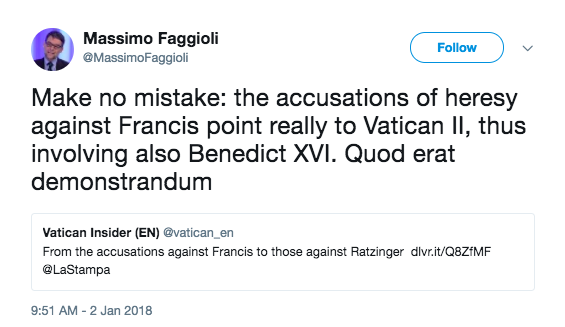
UPDATED: Bergoglio And Ratzinger: Two Peas In A Pod?

So, on January 2, "theologian" and internet gadfly Massimo Faggioli (aka "Maximum Beans) presented what appears to be the new Bergoglian talking point: an attack on Bergoglio is ipso facto an attack on Ratzinger--darling of Vatican II "conservative" Catholics. And an attack on Ratzinger is, ipso facto, an attack on Vatican II itself, since Ratzinger was one of the Modernist clique that led and directed the Council to their desired end. So, lay off Bergoglio unless you want to jeopardize the entire Ratzingerean legacy or--God forbid!--position yourselves on the "the wrong side of history":


This "narrative" that Faggioli deprecates is, of course, exactly that of Antonio Livi, the Italian philosopher whose book review, L'eresia al potere (Heresy In Power), we translated and examined a couple of days ago. Livi, reviewing the new book by Enrico Maria Radaelli, Al cuore di Ratzinger. Al cuore del mondo (At the heart of Ratzinger, at the heart of the world), makes the irrefutable--because so obvious--case that Ratzinger, far from being "a providential bulwark against what he himself called the dictatorship of relativism," was (with Wojtyla) in effect a Great Enabler of Modernism in the Church in the decades that followed Vatican and throughout his own papacy:

Thursday, January 4, 2018

Ratzinger and Scientific Method

Having written the previous post in response to the Italian lawyer who attempted to criticize Antonio Livi's critique of Ratzinger's views on faith, I did a few online searches. Those searches confirmed a number of things. One is that the world has become a very small place, indeed, with the advent of the internet. I came across an article in the New York Times by the Professor (now emeritus) whose course on Philosophy of Science I took as an undergrad.

The paper I wrote for that course argued that there is not, in fact, any such thing as "scientific method." Rather, I argued, science is simply a refinement and quantification of "common sense" methods of knowledge common to all humanity, i.e., a careful utilization of the normal methods we all use in coming to know the world around us, extended and refined by the use of instrumentation and mathematics. I received a B for that effort.

Over forty years later, my former professor authored the article I just read: There Is No Scientific Method.

A survey of Ratzinger's writing over the decades since Vatican II leads to the conclusion that his views remain essentially unchanged, to include his naive views on scientific positivism's affect on philosophy, faith, and human knowledge generally. Unfortunately, his views are clearly based on German philosophy from the 18th century that is accepted only by philosophically naive people--such as scientists and theologians. Oh--and Italian lawyers. The truth is that "modern" philosophy doesn't explain "modern" science. Kantian agnosticism is, as Etienne Gilson pointed out, an unjustifiable presupposition. Would that Ratzinger had bothered to actually read and reflect on what the Thomist Gilson had to say, rather than grousing about the scholastic textbooks he (Ratzinger) was required to read in seminary--as Ratzinger has done for the last five decades.

More Ratzinger, Modernism, and Livi - with Legal Input!

On Sandro Magister’s blog this morning there’s a reply to Antonio Livi's critique of Ratzinger, which I covered yesterday. Tellingly, the reply is by a lawyer–not a philosopher. Once again, the blog is in Italian: Joseph Ratzinger teologo. Non “modernista” ma moderno: “Joseph Ratzinger, Theologian: Modern but not ‘Modernist’.” The lawyer/author starts by pronouncing himself “not convinced” by Livi, but then goes on to confirm exactly what Livi said: Ratzinger rejects Thomism, rejects the very notion of praeambula fidei, and adopts instead a “modern”, i.e., Kantian, approach. In essence the lawyer is saying: It's true that Ratzinger is not Thomist and is Kantian--but (the lawyer simply asserts) that's just being "modern," (i.e., it's a good thing), not "Modernist" (which, he presumably agrees, is a bad thing, and is therefore to be denied). In fact, however, it's simple historical fact that Kantian thinking is the very basis of Modernism (cf. the links in yesterday's post, cited above).  It's important to further note, however, that in attempting to make this case the lawyer quite mistakenly identifies modern science with a “methodological atheism.”

Now, it’s quite true that a scientist–insofar as he is a scientist–need not be a metaphysician nor need he explicitly hold any metaphysical principles in order to conduct scientific inqquiries. But by that very same token, there is nothing necessarily atheist about the scientific methodology insofar as it is scientific (as the history of science amply demonstrates). It may be fair to call the scientific method “agnostic”, but even so it is not methodologically or consciously agnostic any more than it is methodologically atheist. Which is to say, a scientist can engage in valid science as a theist, an atheist, or an agnostic simply because such considerations don’t affect his methodology in practice–although the scientific methodology very arguably arose from theistic principles (cf. the work of Stanley Jaki).

What Ratzinger does, and the lawyer is quite explicit about this, is to accept this supposedly methodological atheism of modern science (or, more properly, its “agnosticism”) as controlling for philosophy. IOW, he accepts that "science" in the modern sense of the word is the only truly valid form of human knowledge, and he insists that the man of faith must bow to the scientific method as exclusively valid in all areas of human inquiry. Therefore, in Ratzinger’s view, belief that there is a cause for the existence of all that exists, which we call God, is and can only be an hypothesis. It cannot be a certainty because it is not subject to experimental verification, which Ratzinger implicitly accepts as the only valid form of “modern” knowledge. In this Ratzinger is both very modern and very Modernist, exactly as Livi says. (Parenthetically, it's worth noting that these views are at the bottom of Ratzinger's extreme--and frequently expressed--skepticism regarding the validity of historical critical study of both Scripture as well as history more generally, and it amply explains his preference for subjective, allegorical approaches to Scripture.)

Wednesday, January 3, 2018

Heresy, Thy Name Is Benedict. Or Ratzinger.

Yesterday, the Italian Vaticanist Sandro Magister--a generally mainstream, Vatican II-ish commenter whom I've always regarded as generally sympathetic or respectful towards Joseph Ratzinger/Benedict XVI--hosted a remarkable essay at his Italian language site. The essay is alluded to on the English version of his site, in the blog titled: Ratzinger Rehabilitates Müller. But the Pope Emeritus Himself Is Being Hit with Accusations of Heresy, but the essay itself, L'eresia al potere, has so far only appeared in Italian. That essay appears below in my English translation, with my own comments interjected (in brackets) and with links to other sites that provide some additional information regarding persons and topics that are mentioned.


The essay is written by Antonio Livi, and is introduced by Magister as follows:

"The attack in recent days on Ratzinger as theologian comes in a book just off the press that has as its author Enrico Maria Radaelli, known as the most faithful disciple of Romano Amerio (1905-1997), the Swiss philosopher who in 1985 published in “Iota Unum” the most systematic and detailed accusation against the Catholic Church of the second half of the twentieth century, for having subverted the foundations of doctrine in the name of modern subjectivism.
"Radaelli’s book is entitled “Al cuore di Ratzinger. Al cuore del mondo,” ... What led Radaelli to the decision to accuse Ratzinger’s theology of being subversive as well was the reading and analysis of his [Ratzinger's] best-known and most widely read theological work, ... “Introduction to Christianity” ...;
Now, what is most most striking is that Radaelli ... received immediate support from a theologian and philosopher among the most decorated, Monsignor Antonio Livi, dean emeritus of the faculty of philosophy of the Pontifical Lateran University, a pontifical academic and president of the International Science and Commonsense Association. In Livi’s judgment ... Ratzinger and his theology ... contributed to the ... ever more hegemonic role in the seminaries, in the pontifical universities, on the doctrinal commissions, in the curia dicasteries and at the highest levels of the hierarchy up to the papacy, of what he calls “the modernist theology with its evident heretical drift.” 

I take this as a very positive development--both that an academic as eminent as Livi has put his name to such accusations as well as that his essay has appeared on such a widely read and respected blog as Magister's. It appears that the shock of Bergoglio's manifest heresy has sunk deeply enough that intelligent observers--who initially may have thought that the Church's crisis began only with Bergoglio--have begun to think this whole thing through and have come to the realization that the Bergoglio phenomenon can only be the fruit of long development. Livi places blame squarely on Ratzinger, who has supported heretical positions throughout his long career, beginning even in his seminary days. Of course, the roots of this crisis go much deeper even than Ratzinger and the Modernist clique that hijacked Vatican II. But this is an excellent start for reflection and important enough that I feel justified in reproducing Livi's essay in toto.

Tuesday, May 22, 2012

Cardinal Ratzinger On Europe's Crisis of Culture


A niece of mine recently brought this Ratzinger lecture to my attention.

On July 26, 2005, the day before John Paul II died after a prolonged death watch, Joseph Ratzinger—soon to be Benedict XVI—gave an address at Subiaco on Europe's cultural crisis. This address was in the nature of a campaign speech for the papacy, setting out Ratzinger's views on the position of the Church in the modern world. He was presenting himself as a man of vision with a clear idea of the problems facing the Church—the implication being that he was therefore the right man to lead the Church after the long pontificate of John Paul II. This address is thus a handy summary of Ratzinger/Benedict's views.

Ratzinger begins his address by providing something of a laundry list of important problems facing modern man—symptoms of the cultural crisis. These are, in his view, problems that have developed over the last century and are representative byproducts of a cultural change in the West. Among those problems are the threat of terrorism, including the possibility that terrorists may soon obtain biological and/or nuclear weapons; the reaction to terrorism on the part of “lawful states,” which have adopted internal security measures that rival those previously associated only with dictatorships; the development of bio-technology which casts doubt on the dignity of man as God's image; and the growing inequality in the “distribution of the goods of the earth.” Ratzinger concludes by characterizing this crisis as a crisis of moral strength:
All this shows that the growth of our possibilities has not been matched by a comparable development of our moral energy. Moral strength has not grown together with the development of science; rather, it has diminished, because the technical mentality relegates morality to the subjective realm, while we have need, precisely, of a public morality, a morality that is able to respond to the threats that weigh down on the existence of us all. The real and gravest danger in these times lies, precisely, in this imbalance between technical possibilities and moral energy.
Having stated his view of the problem in general terms, Ratzinger presents his analysis of the crisis under seven headings.

Wednesday, April 4, 2012

Levada's defense of the Catechism

After the initial publication of the Catechism of the Catholic Church then Archbishop William J. Levada published a defense of the new catechism: The New Catechism: An Overview . I say “defense,” because while Levada's presentation of the CCC is an overview, it is also and importantly a response to criticisms that had been leveled at it. That Levada should have presented this defense or overview is hardly surprising, since Levada had been a principal editor of the CCC. Indeed, It was commonly speculated that the reason Pope Benedict XVI appointed Levada as his own successor in the post of Prefect of the Congregation for the Doctrine of the Faith may have included Levada's work on the CCC as well as the fact that the two of them had worked together at the CDF in the past (2000-2003). What I wish to draw attention to in Levada's defense of or presentation of the CCC is the strain of what can only be described as fideism which he displays, in common with his mentor, Joseph Ratzinger/B16. (We previously drew attention to that in our discussion of Ratzinger's lecture on Biblical interpretation: Biblical Interpretation in Crisis: The 1988 Erasmus Lecture). In addition to this fideistic strain, the two men also share another tendency of the Nouvelle Théologie—a conviction that a return to a greater emphasis on the Patristic authors, the “Fathers” of the Church, is a key to renewal in the modern Church. Included in that is a devotion to Patristic modes of scriptural interpretation and a skeptical (if not downright hostile) attitude toward modern historical-critical interpretation—this despite Benedict's repeated but grudging acknowledgments that the historical-critical approach must, in fact, take precedence.

Monday, December 29, 2008

Biblical Interpretation in Crisis: The 1988 Erasmus Lecture

In 1988 Cardinal Ratzinger, then Prefect of the Congregation for the Doctrine of the Faith, came to New York to deliver the Erasmus Lecture. The title of his lecture was Biblical Interpretation in Crisis, which reflected his long running concern with the state of modern Biblical exegesis. In the lecture he set forth his critique of the current troubled state of affairs--which he attributed to the influence of the “historical-critical method”--and offered his “hopes” for the future. This appears to be as good a starting point as any for a consideration of the issues confronting the Church in developing a coherent theory of revelation, and especially because Ratzinger's views, as expressed in 1988, remain unchanged in their essentials to this day.  We will proceed with a running commentary on Ratzinger's somewhat rambling lecture.

Ratzinger quickly sets the tone for his lecture, opening his remarks with an anecdote from Soloviev that portrays modern exegetes as the Antichrist! He then suggests that “[t]o speak of 'the crisis of the historical-critical method' today is practically a truism.” He professes to find this state of affairs, which is to say, the state of affairs as he has painted it, somehow ironic, since the historical-critical method had “gotten off to so optimistic a start” 100 years ago. True, he adds, the historical-critical method as originally conceived during the Enlightenment contained an “impertinent presupposition” which regarded “dogma or church doctrine ... as one of the real impediments to a correct understanding of the Bible itself,” yet Catholic proponents of the historical-critical method assured the Church that the method, once freed of such anti-Christian presuppositions, would provide “strict objectivity” and would bring us closer to “the clear and unmistakable voice of the original message of Jesus.” And, in fact, says Ratzinger, that did initially appear to be the case.

This manner of framing the subject is certainly noteworthy, implying as it does that the historical-critical method is part of an illusory quest for “strict objectivity.” From a philosophical standpoint this formulation clearly implies that Ratzinger falls well within the common Platonic tradition when it comes to the the problem of knowledge. For Platonists (of whatever stripe) knowledge is an all or nothing proposition. Either we attain to a complete grasp of the Ideas (the heavenly archetypes of Mircea Eliade's “archaic ontology”) or ... we have no real knowledge at all! Godlike omniscience or total skepticism, the Scylla and Charybdis that has bedeviled man for millennia. Ratzinger is situating the entire project of historical-critical exegesis within the context of this wrongheaded epistemology.

So, then, what followed from the historical-critical method's optimistic beginnings? Ratzinger first complains that the historical-critical method led to a “confused” picture--use of the method gave rise to a number of apparently conflicting theories. The existence of contradictory theories, says Ratzinger, meant that “access to the Bible” was blocked for all those who were not “initiated” into the complexities of the method (note once again the use of a loaded, pejorative term: “initiated,” with its hint of a gnostic fraternity of illuminati). Furthermore, says Ratzinger, those who were “initiated,” the scholars and exegetes, “were no longer reading the Bible anyway, but were dissecting it into the various parts from which it had to have been composed.” (My emphasis.) In other words, Ratzinger suggests that these exegetes were impious men who ignored what “the Bible” was actually saying, in favor of arcane academic game playing that blocked the simple faithful from access to the clear meaning of the text.

It's clear that Ratzinger disapproves of this situation, but he is less than totally forthcoming about his exact reasoning. For example, he appears to be saying that the “uninitiated,” the simple faithful, should have full “access” to “the Bible.” How reasonable is this contention? There are at least two presuppositions behind this complaint, and probably more.