Pages

Showing posts with label Heresy. Show all posts

Thursday, April 26, 2018

Antonio Livi: There Is A Disturbing Continuity Between Ratzinger And Bergoglio

In January, 2018, I wrote a series of posts on the theme of the philosophical continuity between Ratzinger and Bergoglio, beginning with a translation of a review essay by Professor Antonio Livi. Livi is a former dean and professor of philosophy at the Lateran University in Rome, and was formerly incardinated in Opus Dei. The title of that essay, "Heresy is in Power," expresses a continuing theme in Livi's commentary on the current crisis in the Church. That essay lays much of the blame for the hegemony of Modernist thought in the Church at the feet of Ratzinger, and of Ratzinger's own philosophical errors.

Today Gloria TV published a transcript of a recent interview with Livi in which Livi stated that Bergoglio "was elected to carry out a reform [of the Church] in the Lutheran sense”.  He also flatly stated that:

Francis’ election was a big set-up which will eventually lead to the recognition of Luther and to the creation of a Mass without consecration. According to Livi this revolution was already planned in the early sixties. The last fifty years were marked by the activity of “evil and heretical” theologians in order to conquer power. “Now they have conquered it.”

I also wrote a pair of posts on this same theme--the continuity between Ratzinger and Bergoglio--in March, 2018, stemming from the controversy over Ratzinger's letter that offered a theological endorsement of Bergoglio:

Bergoglio's LetterGate--Continuity and Discontinuity
A Case Study On Continuity Between Ratzinger and Bergoglio: The Spirit And "Living Tradition"

What follows is a brief interview with Livi that appeared in Italian, and which I've translated. In the interview he touches on the same theme of continuity described above, in an enlightening way--including a brief reference to the resistance that otherwise intelligent and honorable people raise to what is "an undeniable theological fact". I will simply add, with regard to Livi's claim that "Today they [Modernists] are in charge of practically all the Vatican dicasteries ", that assuming that Livi is correct in his assessment of Ratzinger's thought--and he is--then this should come as no surprise. Most of the episcopal heroes of the Neo-Catholics of the V2 Church--men such Chaput, Burke, and Pell, have long proclaimed their adherence to Ratzinger's way of thinking. The simple fact is that Wojtyła and Ratzinger largely paved the way for Bergoglio and his German masters.


Monsignor Livi: "In the Church, heresy is in power and ignorance has been canonized"


For the fifth anniversary of the pontificate of Pope Francis, Monsignor Dario Edoardo Viganò, responsible for Vatican communication and Vatican News, revealed a letter from Pope Emeritus Benedict XVI addressed to Pope Francis. We interviewed Monsignor Antonio Livi on this matter.
Professor Livi, does this endorsement [of Francis] by the Pope Emeritus surprise you?
"No. In the end, his letter, even if it does not touch doctrinal issues, proves that I've been right in always maintaining that there is a disturbing continuity between Ratzinger and Bergoglio in the way of exercising the ecclesiastical magisterium. Many (and among them a very esteemed friend, Antonio Socci) do not want to admit it. But from a theological point of view it's an undeniable fact, even if this observation does not imply a critique of Benedict XVI from the point of view of personal sanctity ".
Because?
"Because even previous Popes, including those who are already canonized (like John XXIII and John Paul II) or will soon be (like Paul VI), have not prevented the growing [progressiva] hegemony of neo-modernist theology in the Church. I am presenting a very significant book throughout Italy: "A bishop writes to the Holy See on the pastoral dangers of dogmatic relativism" (Leonardo da Vinci, Rome 2017) [The letters are selected and annotated by Livi.]. These are the letters that Monsignor Mario Oliveri, when he was bishop of Albenga, wrote to Pope John Paul II and to Benedict XVI to implore them to curb the invasion of neomodernistic ideas and praxis in the Church: but bishop Oliveri received no positive response from these Popes. The result is (as I always repeat) that today we have "heresy in power" in the ecclesiastical structures for teaching theology and pastoral government. I'm not surprised by this statement by Ratzinger about the common doctrinal criterion that inspired his pontificate yesterday and today inspires the pontificate of Pope Francis: because Bergoglio and Ratzinger present two faces of the same coin. The German is the cultured and professorial Pastor, the Argentine the populist and demagogue, in search of consensus with the exponents of secular culture ".
Why do you say these things about Ratzinger?
"I know him well, I respect him and venerate him as a man of God. When I had him read (in 2012) the first edition of my treatise on "True and false theology ", he replied in writing praising my work. But he certainly did not share my severe judgment on the false pro-Lutheran Catholic theology, which is opposed to the immutability of dogma and its metaphysical conceptualization, and was accepted by the ecclesiastical magisterium on the basis of Thomist theology and the scholastic tradition. Ratzinger the theologian prefers personalist, existential and dialectical theology: after all, he belongs to the theological progressivism of his friend Karl Rahner. As Prefect of the Congregation for the Doctrine of the Faith, Cardinal Ratzinger often let heresy slide, or at least tolerated it. Maybe it also depends on his delicacy of mind and his meekness. However, it isn't possible to be good theologians and above all good pastors if you don't protect dogma from heresy (and the worst heresy is to say that faith does not need dogmas). He, Ratzinger, is inclined to the relativistic, historicist (according to the hermeneutical school) interpretation of absolute fidelity to dogma ".
He probably wrote those things in defense of the unity of the Church, sensing the danger of a schism ...
"I don't believe it. A substantial schism is already underway. If he really believed in dogma and intended to free the Church from heresy, he did not have to resign or could subsequently disapprove the theses of Pope Francis. I have the feeling that it's skillful role playing. Francis is the demagogue, Ratzinger the cautious one ".
And the Church?
"It's in trouble. It's a result of the seizure of power by modernist theologians, first under the pontificate of John XXIII and later with Vatican II. Today they are in charge of practically all the Vatican dicasteries ".
On TV and in most of the media, to commemorate the five years of the pontificate of Francis, no critical voices were heard or at least they were not asked ...
"It shows that heresy is in power. And we have also canonized ignorance ".

Thursday, March 29, 2018

Be Careful What You Read at "The Catholic Thing"--It May Not Be Catholic

Today the editors at the well known site The Catholic Thing

Editor in Chief: Robert Royal
Senior Editor: Brad Miner 
Managing Editor: Hannah Russo
Associate Managing Editor: Emily Rowles 
Contributing Editors: Rev. James V. Schall, S.J., Mary Eberstadt, Hadley Arkes, George J. Marlin, Rev. Gerald E. Murray, Ralph McInerny (RIP), Michael Novak (RIP), Anthony Esolen, David Warren, Howard Kainz, Rev. C.J. McCloskey, Randall Smith, Rev. Bevil Bramwell, O.M.I.

saw fit to publish an article by Fr. Robert P. Imbelli, Eucharist and New Creation. Who is Imbelli?

Following his graduation from Yale, Imbelli continued his teaching at St. Joseph's Seminary as a professor of systematic theology.[1] Leaving St. Joseph's, Imbelli continued his teaching at the Maryknoll School of Theology. Finally in 1986, he was given a leadership position as Director of the Institute of Religious Education and Pastoral Ministry at Boston College. In 1993, he stepped down from this position and has remained an associate professor of theology.
In addition to teaching, Imbelli has been a prolific contributor to journals and magazines like Commonweal, America and L'Osservatore Romano. He also edited and contributed to a book, Handing on the Faith: the Church's Mission and Challenge, in 2006.[1] In addition to his frequent articles, he maintains an almost daily updated blog on Commonweal.
Imbelli is also the author of Rekindling the Christic Imagination: Theological Meditations for the New Evangelization.

The reference to "the Christic Imagination" is a dead giveaway that we're dealing here with a Teilhardian. "The Christic" is the title of an article that Teilhard de Chardin wrote near the end of his life. If you take a glance at it you'll get a flavor for Teilhard's Gnostic, non-Christian, cosmogony. In it you'll find such gems as:

It is Christ, in very truth, who saves,
— but should we not immediately add that at the same time it is Christ who is saved by
Evolution?

Friday, January 5, 2018

UPDATED: Bergoglio And Ratzinger: Two Peas In A Pod?

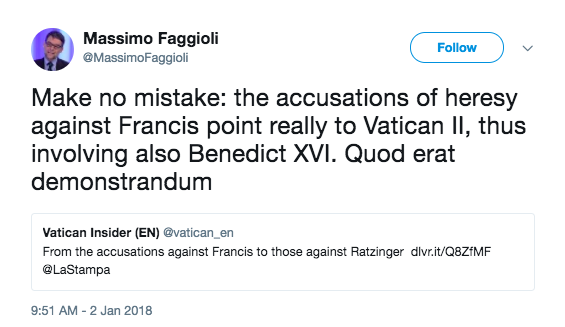
So, on January 2, "theologian" and internet gadfly Massimo Faggioli (aka "Maximum Beans) presented what appears to be the new Bergoglian talking point: an attack on Bergoglio is ipso facto an attack on Ratzinger--darling of Vatican II "conservative" Catholics. And an attack on Ratzinger is, ipso facto, an attack on Vatican II itself, since Ratzinger was one of the Modernist clique that led and directed the Council to their desired end. So, lay off Bergoglio unless you want to jeopardize the entire Ratzingerean legacy or--God forbid!--position yourselves on the "the wrong side of history":


This "narrative" that Faggioli deprecates is, of course, exactly that of Antonio Livi, the Italian philosopher whose book review, L'eresia al potere (Heresy In Power), we translated and examined a couple of days ago. Livi, reviewing the new book by Enrico Maria Radaelli, Al cuore di Ratzinger. Al cuore del mondo (At the heart of Ratzinger, at the heart of the world), makes the irrefutable--because so obvious--case that Ratzinger, far from being "a providential bulwark against what he himself called the dictatorship of relativism," was (with Wojtyla) in effect a Great Enabler of Modernism in the Church in the decades that followed Vatican and throughout his own papacy:

Thursday, January 4, 2018

More Ratzinger, Modernism, and Livi - with Legal Input!

On Sandro Magister’s blog this morning there’s a reply to Antonio Livi's critique of Ratzinger, which I covered yesterday. Tellingly, the reply is by a lawyer–not a philosopher. Once again, the blog is in Italian: Joseph Ratzinger teologo. Non “modernista” ma moderno: “Joseph Ratzinger, Theologian: Modern but not ‘Modernist’.” The lawyer/author starts by pronouncing himself “not convinced” by Livi, but then goes on to confirm exactly what Livi said: Ratzinger rejects Thomism, rejects the very notion of praeambula fidei, and adopts instead a “modern”, i.e., Kantian, approach. In essence the lawyer is saying: It's true that Ratzinger is not Thomist and is Kantian--but (the lawyer simply asserts) that's just being "modern," (i.e., it's a good thing), not "Modernist" (which, he presumably agrees, is a bad thing, and is therefore to be denied). In fact, however, it's simple historical fact that Kantian thinking is the very basis of Modernism (cf. the links in yesterday's post, cited above).  It's important to further note, however, that in attempting to make this case the lawyer quite mistakenly identifies modern science with a “methodological atheism.”

Now, it’s quite true that a scientist–insofar as he is a scientist–need not be a metaphysician nor need he explicitly hold any metaphysical principles in order to conduct scientific inqquiries. But by that very same token, there is nothing necessarily atheist about the scientific methodology insofar as it is scientific (as the history of science amply demonstrates). It may be fair to call the scientific method “agnostic”, but even so it is not methodologically or consciously agnostic any more than it is methodologically atheist. Which is to say, a scientist can engage in valid science as a theist, an atheist, or an agnostic simply because such considerations don’t affect his methodology in practice–although the scientific methodology very arguably arose from theistic principles (cf. the work of Stanley Jaki).

What Ratzinger does, and the lawyer is quite explicit about this, is to accept this supposedly methodological atheism of modern science (or, more properly, its “agnosticism”) as controlling for philosophy. IOW, he accepts that "science" in the modern sense of the word is the only truly valid form of human knowledge, and he insists that the man of faith must bow to the scientific method as exclusively valid in all areas of human inquiry. Therefore, in Ratzinger’s view, belief that there is a cause for the existence of all that exists, which we call God, is and can only be an hypothesis. It cannot be a certainty because it is not subject to experimental verification, which Ratzinger implicitly accepts as the only valid form of “modern” knowledge. In this Ratzinger is both very modern and very Modernist, exactly as Livi says. (Parenthetically, it's worth noting that these views are at the bottom of Ratzinger's extreme--and frequently expressed--skepticism regarding the validity of historical critical study of both Scripture as well as history more generally, and it amply explains his preference for subjective, allegorical approaches to Scripture.)

Wednesday, January 3, 2018

Heresy, Thy Name Is Benedict. Or Ratzinger.

Yesterday, the Italian Vaticanist Sandro Magister--a generally mainstream, Vatican II-ish commenter whom I've always regarded as generally sympathetic or respectful towards Joseph Ratzinger/Benedict XVI--hosted a remarkable essay at his Italian language site. The essay is alluded to on the English version of his site, in the blog titled: Ratzinger Rehabilitates Müller. But the Pope Emeritus Himself Is Being Hit with Accusations of Heresy, but the essay itself, L'eresia al potere, has so far only appeared in Italian. That essay appears below in my English translation, with my own comments interjected (in brackets) and with links to other sites that provide some additional information regarding persons and topics that are mentioned.


The essay is written by Antonio Livi, and is introduced by Magister as follows:

"The attack in recent days on Ratzinger as theologian comes in a book just off the press that has as its author Enrico Maria Radaelli, known as the most faithful disciple of Romano Amerio (1905-1997), the Swiss philosopher who in 1985 published in “Iota Unum” the most systematic and detailed accusation against the Catholic Church of the second half of the twentieth century, for having subverted the foundations of doctrine in the name of modern subjectivism.
"Radaelli’s book is entitled “Al cuore di Ratzinger. Al cuore del mondo,” ... What led Radaelli to the decision to accuse Ratzinger’s theology of being subversive as well was the reading and analysis of his [Ratzinger's] best-known and most widely read theological work, ... “Introduction to Christianity” ...;
Now, what is most most striking is that Radaelli ... received immediate support from a theologian and philosopher among the most decorated, Monsignor Antonio Livi, dean emeritus of the faculty of philosophy of the Pontifical Lateran University, a pontifical academic and president of the International Science and Commonsense Association. In Livi’s judgment ... Ratzinger and his theology ... contributed to the ... ever more hegemonic role in the seminaries, in the pontifical universities, on the doctrinal commissions, in the curia dicasteries and at the highest levels of the hierarchy up to the papacy, of what he calls “the modernist theology with its evident heretical drift.” 

I take this as a very positive development--both that an academic as eminent as Livi has put his name to such accusations as well as that his essay has appeared on such a widely read and respected blog as Magister's. It appears that the shock of Bergoglio's manifest heresy has sunk deeply enough that intelligent observers--who initially may have thought that the Church's crisis began only with Bergoglio--have begun to think this whole thing through and have come to the realization that the Bergoglio phenomenon can only be the fruit of long development. Livi places blame squarely on Ratzinger, who has supported heretical positions throughout his long career, beginning even in his seminary days. Of course, the roots of this crisis go much deeper even than Ratzinger and the Modernist clique that hijacked Vatican II. But this is an excellent start for reflection and important enough that I feel justified in reproducing Livi's essay in toto.