Pages

Showing posts with label Benedict. Show all posts

Thursday, March 29, 2018

Be Careful What You Read at "The Catholic Thing"--It May Not Be Catholic

Today the editors at the well known site The Catholic Thing

Editor in Chief: Robert Royal
Senior Editor: Brad Miner 
Managing Editor: Hannah Russo
Associate Managing Editor: Emily Rowles 
Contributing Editors: Rev. James V. Schall, S.J., Mary Eberstadt, Hadley Arkes, George J. Marlin, Rev. Gerald E. Murray, Ralph McInerny (RIP), Michael Novak (RIP), Anthony Esolen, David Warren, Howard Kainz, Rev. C.J. McCloskey, Randall Smith, Rev. Bevil Bramwell, O.M.I.

saw fit to publish an article by Fr. Robert P. Imbelli, Eucharist and New Creation. Who is Imbelli?

Following his graduation from Yale, Imbelli continued his teaching at St. Joseph's Seminary as a professor of systematic theology.[1] Leaving St. Joseph's, Imbelli continued his teaching at the Maryknoll School of Theology. Finally in 1986, he was given a leadership position as Director of the Institute of Religious Education and Pastoral Ministry at Boston College. In 1993, he stepped down from this position and has remained an associate professor of theology.
In addition to teaching, Imbelli has been a prolific contributor to journals and magazines like Commonweal, America and L'Osservatore Romano. He also edited and contributed to a book, Handing on the Faith: the Church's Mission and Challenge, in 2006.[1] In addition to his frequent articles, he maintains an almost daily updated blog on Commonweal.
Imbelli is also the author of Rekindling the Christic Imagination: Theological Meditations for the New Evangelization.

The reference to "the Christic Imagination" is a dead giveaway that we're dealing here with a Teilhardian. "The Christic" is the title of an article that Teilhard de Chardin wrote near the end of his life. If you take a glance at it you'll get a flavor for Teilhard's Gnostic, non-Christian, cosmogony. In it you'll find such gems as:

It is Christ, in very truth, who saves,
— but should we not immediately add that at the same time it is Christ who is saved by
Evolution?

Friday, March 23, 2018

A Case Study On Continuity Between Ratzinger and Bergoglio: The Spirit And "Living Tradition"

Back on March 17, 2018, Fr Hunwicke pointed out in his blog post Heureka! Heureka! that

"The first and fontal dogma there attributed [in Wikipedia] to 'Modern Church' [i.e., Modernism] is ... lo and behold ... the prime distinctive dogma of Bergoglianism:
"DIVINE REVELATION HAS NOT COME TO AN END"!!! 

What Fr Hunwicke is referring to is Bergoglio's constant contention that the Holy Spirit is speaking to him and that he is only doing what the Spirit bids him to do. The "God of surprises" communicates His surprises to Bergoglio through the Spirit. And we all know that whoever sins against the Spirit commits the unforegiveable sin. (Mark 3:28-29)

Fr Hunwicke appeared to believe that this notion, that revelation has not come to an end--which I refer to as "continuing revelation"--is a dogma that is distinctive of "Bergoglianism." In the comments I sought to rectify that misconception. It certainly is a distinctive mark of Bergoglianism, but it's just as certainly not unique to Bergoglianism. What, to me, makes this question a matter of some topical interest is that within a few days of Fr Hunwicke's post the whole question of an "inner continuity" between the pontificates of Ratzinger and Bergoglio took on added significance due to the famous letter of Ratzinger. In the letter Ratzinger responded to what amounted to a request that he endorse Bergoglio's ideas, as described in "eleven small volumes" by a variety of pro-Bergoglio theologians. I wrote about that controversy in Bergoglio's LetterGate--Continuity and Discontinuity, my central contention being that Ratzinger was quite correct in pointing out the "inner continuity" between his pontificate and that of Bergoglio. This fact of substantial theological agreement is, of course, exactly what Ratzinger cultists are in a complete state of denial about. To admit it would bring their entire worldview crashing down on their heads.

At any rate, wishing to bring some clarity to the matter, I commented on Fr Hunwicke's blog:

But, speaking of "continuing revelation," that, of course, is a position that Ratzinger was accused of holding as far back as his seminary days and right through his Dei Verbum days up to the present. A point of "inner continuity" with Bergoglio? [Dei Verbum, the Word of God, is the Dogmatic Constitution on Revelation, at Vatican II.]

Wednesday, January 10, 2018

Another Attempted Defense of Ratzinger's Orthodoxy

Sandro Magister has published a second blog in which a writer attempts to defend Ratzinger's orthodoxy against Antonio Livi's initial critique of RatzingerWhy Ratzinger Is Not a Heretic. As in the case of the first defense of Ratzinger that Magister published, this defense is written by a person who is not a professional, philosopher: Francesco Arzillo, "an administrative magistrate of Rome who is also an esteemed author of works of philosophy and theology." While avoiding addressing the specifics of Livi's critique of Ratzinger--which revolve around Ratzinger's concept of faith--Arzillo attempts to portray Ratzinger's views as substantially identical to those attributed in Acts to St. Paul in his address to the Greeks at the Areopagus. This metaphor has a certain significance. Paul's address at the Areopagus is regarded as a model for the Church's outreach to non-believers and an expression of the Church's natural theology, so Arzillo is using this metaphor to suggest the same regarding Ratzinger: not only is Ratzinger to be viewed as a bulwark against heretics but he's a model for outreach to non-believers. As we will see, however, Ratzinger's attempts to assimilate Paul's views to his own simply don't work. Arzillo begins his defense by quoting a number of passages from an address Ratzinger gave in Paris as Benedict XVI.

Friday, January 5, 2018

UPDATED: Bergoglio And Ratzinger: Two Peas In A Pod?

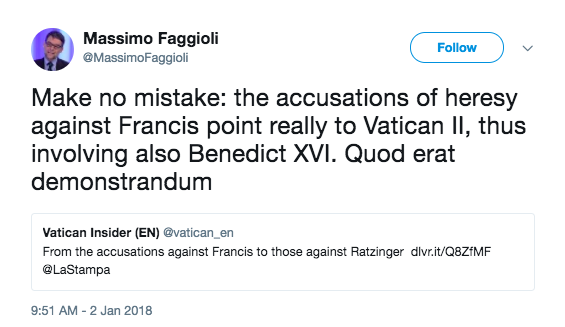
So, on January 2, "theologian" and internet gadfly Massimo Faggioli (aka "Maximum Beans) presented what appears to be the new Bergoglian talking point: an attack on Bergoglio is ipso facto an attack on Ratzinger--darling of Vatican II "conservative" Catholics. And an attack on Ratzinger is, ipso facto, an attack on Vatican II itself, since Ratzinger was one of the Modernist clique that led and directed the Council to their desired end. So, lay off Bergoglio unless you want to jeopardize the entire Ratzingerean legacy or--God forbid!--position yourselves on the "the wrong side of history":


This "narrative" that Faggioli deprecates is, of course, exactly that of Antonio Livi, the Italian philosopher whose book review, L'eresia al potere (Heresy In Power), we translated and examined a couple of days ago. Livi, reviewing the new book by Enrico Maria Radaelli, Al cuore di Ratzinger. Al cuore del mondo (At the heart of Ratzinger, at the heart of the world), makes the irrefutable--because so obvious--case that Ratzinger, far from being "a providential bulwark against what he himself called the dictatorship of relativism," was (with Wojtyla) in effect a Great Enabler of Modernism in the Church in the decades that followed Vatican and throughout his own papacy:

Thursday, January 4, 2018

Ratzinger and Scientific Method

Having written the previous post in response to the Italian lawyer who attempted to criticize Antonio Livi's critique of Ratzinger's views on faith, I did a few online searches. Those searches confirmed a number of things. One is that the world has become a very small place, indeed, with the advent of the internet. I came across an article in the New York Times by the Professor (now emeritus) whose course on Philosophy of Science I took as an undergrad.

The paper I wrote for that course argued that there is not, in fact, any such thing as "scientific method." Rather, I argued, science is simply a refinement and quantification of "common sense" methods of knowledge common to all humanity, i.e., a careful utilization of the normal methods we all use in coming to know the world around us, extended and refined by the use of instrumentation and mathematics. I received a B for that effort.

Over forty years later, my former professor authored the article I just read: There Is No Scientific Method.

A survey of Ratzinger's writing over the decades since Vatican II leads to the conclusion that his views remain essentially unchanged, to include his naive views on scientific positivism's affect on philosophy, faith, and human knowledge generally. Unfortunately, his views are clearly based on German philosophy from the 18th century that is accepted only by philosophically naive people--such as scientists and theologians. Oh--and Italian lawyers. The truth is that "modern" philosophy doesn't explain "modern" science. Kantian agnosticism is, as Etienne Gilson pointed out, an unjustifiable presupposition. Would that Ratzinger had bothered to actually read and reflect on what the Thomist Gilson had to say, rather than grousing about the scholastic textbooks he (Ratzinger) was required to read in seminary--as Ratzinger has done for the last five decades.