I frankly haven't been paying much attention to the Neo Gnostic Amazon Synod going on at the Vatican these days. Most of the commentary on it has been all too predictable--handwringing or platitudes, but nothing terribly incisive. Today at First Things, however, Douglas Farrow, a Professor of Theology and Christian Thought at McGill University, gets to the heart of the matter in an article that wastes no time getting to the point: THE AMAZON SYNOD IS A SIGN OF THE TIMES. I have long maintained, although not at this blog, that the crisis in American and the West generally is closely connected to the crisis in what used to be the Catholic Church (if you object to that statement, please read on). I don't mean that in a general sense, although that general cultural sense is also true. I mean it in a very specific sense in that the same globalist actors--prominently, George Soros, are at work both within society generally as well as now within the Catholic Church itself. Or, within what used to be the Catholic Church. Farrow is no bomb thrower. He has considered what he needs to say carefully. Herewith some excerpts to give you an inducement to read the whole article:


For
the fifth anniversary of the pontificate of Pope Francis, Monsignor
Dario Edoardo Viganò, responsible for Vatican communication and Vatican
News, revealed a letter from Pope Emeritus Benedict XVI addressed to
Pope Francis. We interviewed Monsignor Antonio Livi on this matter.
Professor Livi, does this endorsement [of Francis] by the Pope Emeritus surprise you?
"No.
In the end, his letter, even if it does not touch doctrinal issues,
proves that I've been right in always maintaining that there is a
disturbing continuity between Ratzinger and Bergoglio in the way of
exercising the ecclesiastical magisterium. Many (and among them a very esteemed friend, Antonio Socci) do not want to admit it. But
from a theological point of view it's an undeniable fact, even if this
observation does not imply a critique of Benedict XVI from the point of
view of personal sanctity ".
Because?
"Because
even previous Popes, including those who are already canonized (like
John XXIII and John Paul II) or will soon be (like Paul VI), have not
prevented the growing [progressiva] hegemony of neo-modernist theology in the Church. I am presenting a very significant book throughout Italy: "A bishop writes to the Holy See on the pastoral dangers of dogmatic relativism" (Leonardo da Vinci, Rome 2017) [The letters are selected and annotated by Livi.]. These
are the letters that Monsignor Mario Oliveri, when he was bishop of
Albenga, wrote to Pope John Paul II and to Benedict XVI to implore them
to curb the invasion of neomodernistic ideas and praxis in the Church:
but bishop Oliveri received no positive response from these Popes. The
result is (as I always repeat) that today we have "heresy in power" in
the ecclesiastical structures for teaching theology and pastoral
government. I'm
not surprised by this statement by Ratzinger about the common doctrinal
criterion that inspired his pontificate yesterday and today inspires
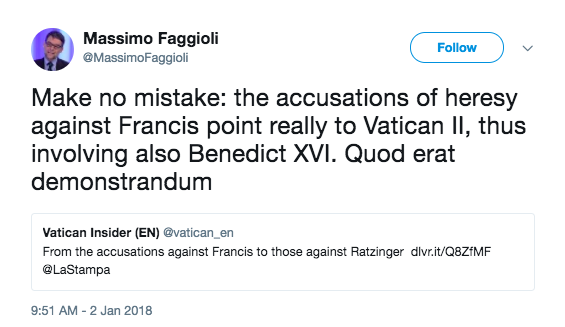
the pontificate of Pope Francis: because Bergoglio and Ratzinger present two faces of the same coin. The
German is the cultured and professorial Pastor, the Argentine the
populist and demagogue, in search of consensus with the exponents of
secular culture ".
Why do you say these things about Ratzinger?
"I
know him well, I respect him and venerate him as a man of God. When I
had him read (in 2012) the first edition of my treatise on "True and
false theology ", he replied in writing praising my work. But
he certainly did not share my severe judgment on the false pro-Lutheran
Catholic theology, which is opposed to the immutability of dogma and
its metaphysical conceptualization, and was accepted by the
ecclesiastical magisterium on the basis of Thomist theology and the
scholastic tradition. Ratzinger
the theologian prefers personalist, existential and dialectical
theology: after all, he belongs to the theological progressivism of his
friend Karl Rahner. As
Prefect of the Congregation for the Doctrine of the Faith, Cardinal
Ratzinger often let heresy slide, or at least tolerated it. Maybe it also depends on his delicacy of mind and his meekness. However,
it isn't possible to be good theologians and above all good pastors if
you don't protect dogma from heresy (and the worst heresy is to say that
faith does not need dogmas). He,
Ratzinger, is inclined to the relativistic, historicist (according to
the hermeneutical school) interpretation of absolute fidelity to dogma
".
He probably wrote those things in defense of the unity of the Church, sensing the danger of a schism ...
"I don't believe it. A substantial schism is already underway. If
he really believed in dogma and intended to free the Church from
heresy, he did not have to resign or could subsequently disapprove the
theses of Pope Francis. I have the feeling that it's skillful role playing. Francis is the demagogue, Ratzinger the cautious one ".
And the Church?
"It's in trouble. It's
a result of the seizure of power by modernist theologians, first under
the pontificate of John XXIII and later with Vatican II. Today they are in charge of practically all the Vatican dicasteries ".
On
TV and in most of the media, to commemorate the five years of the
pontificate of Francis, no critical voices were heard or at least they
were not asked ...
"It shows that heresy is in power. And we have also canonized ignorance ".