Pages

Friday, February 23, 2018

John Lamont: The Bergoglian Assault on the Faith

I've just finished reading John Lamont's lengthy essay at Rorate Coeli: "The Meaning of Amoris Laetitia According to Pope Francis." This essay, in my view, has a direct bearing on an issue raised by Fr Hunwicke's recent blog post Sedevacantism. In that post Fr Hunwicke posed the question:

"Suppose a pope were, additionally, to require of every Catholic explicit assent ex animo to heresy as a necessary condition for Communion with himself, what would be the situation?"

Lamont's essay is important because it 1) sets out the principles of how we must proceed in judging situations such as the current crisis in the Church, and 2) he follows through and draws conclusions, as well as pointing out what steps need to be taken--but have not been taken.

Thursday, February 8, 2018

Of London, Rome, And Christopher Steele

In Christopher Steele As Frontman I briefly alluded to a somewhat obscure aspect of Steele's activities:
No wonder Steele has been so reticent to testify under oath. Especially since, if he retains ties to British Intelligence he could be prosecuted for espionage under British law for simultaneously working as a source for the FBI.
I believe it's a well established fact that British Intelligence (GCHQ) as well as the Intelligence Services of several other European countries (including, really, Estonia!) colluded with US Government agencies (presumably the CIA) in the effort to avert a Trump presidency. Perhaps they feared Trump, or perhaps they naively believed the MSM narrative that President Hillary was inevitable and thought this was a smart way to curry favor with the incoming administration. It backfired and, in the case of the British, in a very public way: GCHQ boss Robert Hannigan quits for 'personal reasons' after just two years. Right--who wanted that job anyway? And what was that date? January 23, 2017, giving only three days notice? Surely this had nothing to do with Trump being inaugurated, when was that? January 20, 2017, the very same day Hannigan gave his notice? Yes, very messy, and we can probably trace PM May's rocky relationship with Trump to this, oh, misunderstanding.

But, Steele. What are the possibilities regarding his intelligence affiiliations? Perhaps he still works for British Intelligence in some role, even after his retirement. After all, the fulsome praise for Steele in yesterday's WaPo profile of the former spy could be taken that way:

Wednesday, February 7, 2018

UPDATE: IMPORTANT: Rep. Jim Jordan's Timeline to the Election

In an interview with Fox News Rep. Jim Jordan very handily ties together all the dates and events we've been referencing into a convenient timeline--one that is pregnant with meaning--and then shows the importance of those dates and events to the blockbuster story of today: Obama's desire to know everything the FBI is doing (as stated in a 9/2/16 Lisa Page text to Peter Strzok).

Harris Faulkner begins the interview by asking whether Jordan thinks this new text revelation is a "problem" for Obama. In response Jordan immediately points out that the text has to be understand in the context of a timeline, and proceeds to sketch that timeline out.

July 5: Hillary Email Investigation--closed.

Later in July: Strzok opens Trump/Russia investigation.

Sept 2: "POTUS wants to know EVERYTHING we're doing."

Having laid out the bare bones of the timeline, Jordan doubles back: Understand, he says, that between the opening of the Trump/Russia investigation and the September 2 "POTUS wants to know EVERYTHING" text comes the "insurance policy" text on 8/16/16. Then, just to make sure Faulkner gets the significance of what he has in mind, Jordan repeats the timeline, this time inserting the "insurance policy" text:

July 5: Hillary Email Investigation--closed.

Later in July: Strzok opens Trump/Russia investigation.

Aug 16: "Insurance Policy" text.

Sept 2: "POTUS wants to know EVERYTHING we're doing."

Jordan's point is that the Hillary Email Investigation is well past, as we pointed out earlier. Therefore, "potus wants to know everything we're doing" can't be focused on Hillary's emails. Of course, since POTUS wants to know everything, if something new comes up on that he'll want to know about it, but that's not the focus. The focus is on the future, the remaining weeks before the election. Jordan is quite clear in his mind that the key to all this is the "insurance policy" text, which comes between the opening of Russia/Trump and the Potus wanting to know everything the FBI is doing.

Now, Jordan thinks the reference to an "insurance policy" means that Strzok is saying that the FBI needs something that will "guarantee" that Trump won't get elected. Therefore, he's suggesting that Obama wants to know everything the FBI is doing to guarantee that Trump won't get elected. Here I think Jordan's a bit off track, in the sense that it's not that simple.

UPDATE: News Is Coming Fast And Furious Today

The big news, of course, is the release of new Strzok/Lisa Page texts, and especially one dated Septermber 2, 2016, in which Lisa Page says Comey will be briefing Obama, adding "potus wants to know everything we're doing."

According to Fox News "this text raises questions about Obama’s personal involvement in the Clinton email investigation." However, I'm a bit skeptical. Of course, "everything" means "everything," so if the FBI did something on the Clinton email investigation then Obama would want to know that. But that investigation had supposedly been disposed of, with Hillary exonerated, back on July 5, 2016--two months before the text, and close two months before Comey's decision to take a New Look at that "matter."

So, in context, my guess is that Rep. Louis Gohmert is correct in saying that this means "the President [Obama] wants to know what they [the FBI] are doing to try to stop Trump.” "Stop" might be a bit, but only a bit, strong. Perhaps "undermine" would be a better description of the FBI's role.

All in all, this is Very Big. I think it's been more or less assumed all along, but to have it confirmed in black and white ...

UPDATED: Christopher Steele As Frontman

This will be short and sweet. Well, the sweetness will depend on individual taste.

What seems to be slowly emerging from the murky background of the Russia Hoax--or perhaps I should be saying The Great Russia Hoax--is that Christopher Steele was more of a frontman for the "dossier" than an actual author. While his writing skills are not in doubt, honed as they were in his days as a student Leftist at Cambridge, it's becoming clear that his true usefulness to the Clinton Campaign had to do with his credentials. The FBI and DoJ couldn't very well go in front of the FISC with an application and attached affidavit and tell the judge, This is something that Nellie and the boys or, as might be, Sid and the boys, came up with. No, much better to be able to talk about a former Spook from an allied country with experience of Russian matters, who has Russian sources, who knows their tradecraft, methods, and goals. Who is familiar with their desire to sully the purity of our political processes. And perhaps best of all, conservatives and Republicans tend to be an Anglophilic bunch, and thus less inclined to question the representations of a source from "British Intelligence."

On closer examination, that narrative didn't hold up well to closer examination. Assuming the truth of what we've been told about Steele, he hadn't been in Russia for many years, hadn't even been in MI-6 for quite a few years. His "sources," such as they were and given the tumult of Russian politics since the end of the Cold War, could be regarded as stale at this point, without further authentication. And, importantly, since he admits at the very least to have been dealing with these sources through intermediaries, verification of any of their assertions would be problematic--to say the least.

Tuesday, February 6, 2018

UPDATED: About That Insurance Policy

This morning at Gateway Pundit an alternative theory is floated regarding Carter Page. In a way you could say that it's similar to the theory I advanced yesterday, that Carter Page was the "insurance policy" for the FBI--but at least 50% in a CYA sense. The Gateway theory riffs off the new information that indicates that Carter Page remained on the FBI's books as some type of informant or cooperating witness--UCE-1 in the 2013 Three Russian Comrades case--right up to March, 2016. Keep that date in mind, because by March, 2016 Trump was looking to be unbeatable in the Republican Presidential candidacy race. Only a few months later after the Russia case was finally concluded and Trump was being simultaneously recognized as the overwhelmingly likely Republican nominee--by July, 2016--Carter Page was magically transformed from FBI Undercover Employee 1 to Carter Page Master Spy. To celebrate this transformation, a real landmark in the Russia Hoax, the FBI opened a Full Investigation on Carter Page. That meant, among other things, that among the investigative techniques that could be deployed against Page was--you guessed it--FISA.

Now, recall that my theory yesterday posited that the August 16, 2016, text between Strzok and Lisa Page referred to a strategic meeting of the top FBI CI players plus Deputy Director Andy McCabe--a meeting at which, in my theory, the decision was made to utilize Carter Page as "it", the insurance policy in the form of a FISA target.
"I want to believe the path you threw out for consideration in Andy’s office — that there’s no way he gets elected — but I'm afraid we can’t take that risk. It’s like an insurance policy in the unlikely event you die before you're 40."
My view then was that this was in good measure a defensive move: to protect or insure against the event of a Trump presidency, in the sense of offering a justification for the spying that the FBI had already been engaged in against Trump associates.

The Gateway theory poses the question:

Monday, February 5, 2018

UPDATED: The Dem Carter Page Playbook--For Today.

So, Politico this morning reveals the talking point of the moment for Democrats: Whatever Carter Page got from the FBI, he deserved it.  Because, Russia!

Why Carter Page Was Worth Watching
There’s plenty of evidence that the former Trump campaign adviser, for all his quirks, was on suspiciously good terms with Russia.

OMG! Suspicion! Embrace your inner totalitarian! We need wall to wall electronic coverage of that guy's life yesterday!

So the author starts with the whole 2013 episode, and he tries to play it ominous, yet can't help revealing the joke of it all:
The Russian spies, however, had one promising lead. This was a guy—an energy consultant based in New York City. Unlike the women, he was eager to help. And, it appeared, keen to make money in Moscow. There was a drawback: The source—whom the FBI called “Male-1”—was something of a dimwit.
There we are again: the hapless Carter Page. But, not so honestly, the author utterly fails to disclose, in the lengthy summary of 2013 events, that Page actually cooperated with the FBI against he Russians.

Sunday, February 4, 2018

My Theory of the Carter Page FISA Fraud

One of the major mysteries of the whole Russia Hoax is: what's all the fuss about Carter Page? Why a FISA on him, of all persons? Bill Jacobson at Legal Insurrection sums up the view of skeptics well:
Carter Page was so important the FBI went out on a limb to use a questionable document in court to convince a judge to surveil him? I’m not buying it. ...
The surveillance of Carter Page was not about Carter Page. He’s a bit player in a larger drama, and that larger drama is what we need to understand.
We already know what the larger drama is--the attempt to prevent a Trump presidency or, failing that, to abort it. At this point it may not be possible to determine exactly how Carter Page fits into that larger drama, but while awaiting further developments we can at least advance a theory. After all, that's how science progresses, right? You advance a theory and let others try to knock it down or refine it. So, in the spirit of good, clean fun, let's have a go at it.

First, a bit of background on Carter Page's recent activity as it relates to Russian intelligence activity. Back in March to June of 2013 the FBI learned, through its ongoing FISA coverage of Russian nationals in the US, that Carter Page was in contact with Russians in whom the FBI had a particular interest. Did the FBI run out and seek a FISA on Carter Page upon discovering his contacts? Of course not. Like any sensible and professional counterintelligence agency, the FBI opened a preliminary investigation of Carter Page to get an better handle on who he was and where he was coming from, then they interviewed him. He apparently was fully cooperative, and you can read an entertaining account of it all in the FBI's court filing in the case against the Russians (Page is definitely "Male 1" in paragraphs 32-34 and I'm guessing he may also be CS 1--Confidential Source 1--in paragraphs 66-74.)

The point is that, after this high profile fiasco, the Russian SVR would certainly have conducted a damage assessment and they would have had to have been brain dead not to realize that Carter Page had cooperated with the FBI. The idea that they would turn around and try to make Page into a master spy in the Trump campaign three short years later strains credulity--to put it mildly. So keep that in mind as we take a look at the 2016 presidential campaign.

Tuesday, January 16, 2018

This is Bergoglio's Game

How many times have you heard people say things like: "Bergoglio is really very traditional--he talks about the devil all the time?"

Today at Catholic World Report you can read in an article about reform of the Roman Curia--yes, a joke topic if ever there was one--the following:

[Bergoglio's] constant recommendation to pastors, that they foster and encourage popular piety and private devotion among the faithful, is water in the desert.

OK, so what's "popular piety and private devotion"? For the sake of argument, let's say that a major form would be Marian piety and especially, saying the rosary. That seems to be what the author has in mind, since he cites Bergoglio's "personal simplicity and deep devotion to Our Lady."

Question: Does "deep devotion to Our Lady" preclude a determination to utterly sweep away every vestige of an objective moral order? It would seem not, based on Bergoglio's own example. After all, Amoris Laetitia to one side, we've all seen his interviews with the atheist journalist Eugenio Scalfari, Bergoglio's chosen mouthpiece to the world. In them we can read such nuggets as this:

Wednesday, January 10, 2018

Another Attempted Defense of Ratzinger's Orthodoxy

Sandro Magister has published a second blog in which a writer attempts to defend Ratzinger's orthodoxy against Antonio Livi's initial critique of RatzingerWhy Ratzinger Is Not a Heretic. As in the case of the first defense of Ratzinger that Magister published, this defense is written by a person who is not a professional, philosopher: Francesco Arzillo, "an administrative magistrate of Rome who is also an esteemed author of works of philosophy and theology." While avoiding addressing the specifics of Livi's critique of Ratzinger--which revolve around Ratzinger's concept of faith--Arzillo attempts to portray Ratzinger's views as substantially identical to those attributed in Acts to St. Paul in his address to the Greeks at the Areopagus. This metaphor has a certain significance. Paul's address at the Areopagus is regarded as a model for the Church's outreach to non-believers and an expression of the Church's natural theology, so Arzillo is using this metaphor to suggest the same regarding Ratzinger: not only is Ratzinger to be viewed as a bulwark against heretics but he's a model for outreach to non-believers. As we will see, however, Ratzinger's attempts to assimilate Paul's views to his own simply don't work. Arzillo begins his defense by quoting a number of passages from an address Ratzinger gave in Paris as Benedict XVI.

Friday, January 5, 2018

UPDATED: Bergoglio And Ratzinger: Two Peas In A Pod?

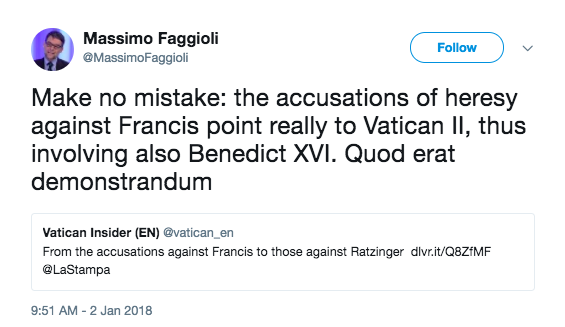
So, on January 2, "theologian" and internet gadfly Massimo Faggioli (aka "Maximum Beans) presented what appears to be the new Bergoglian talking point: an attack on Bergoglio is ipso facto an attack on Ratzinger--darling of Vatican II "conservative" Catholics. And an attack on Ratzinger is, ipso facto, an attack on Vatican II itself, since Ratzinger was one of the Modernist clique that led and directed the Council to their desired end. So, lay off Bergoglio unless you want to jeopardize the entire Ratzingerean legacy or--God forbid!--position yourselves on the "the wrong side of history":


This "narrative" that Faggioli deprecates is, of course, exactly that of Antonio Livi, the Italian philosopher whose book review, L'eresia al potere (Heresy In Power), we translated and examined a couple of days ago. Livi, reviewing the new book by Enrico Maria Radaelli, Al cuore di Ratzinger. Al cuore del mondo (At the heart of Ratzinger, at the heart of the world), makes the irrefutable--because so obvious--case that Ratzinger, far from being "a providential bulwark against what he himself called the dictatorship of relativism," was (with Wojtyla) in effect a Great Enabler of Modernism in the Church in the decades that followed Vatican and throughout his own papacy:

Thursday, January 4, 2018

Ratzinger and Scientific Method

Having written the previous post in response to the Italian lawyer who attempted to criticize Antonio Livi's critique of Ratzinger's views on faith, I did a few online searches. Those searches confirmed a number of things. One is that the world has become a very small place, indeed, with the advent of the internet. I came across an article in the New York Times by the Professor (now emeritus) whose course on Philosophy of Science I took as an undergrad.

The paper I wrote for that course argued that there is not, in fact, any such thing as "scientific method." Rather, I argued, science is simply a refinement and quantification of "common sense" methods of knowledge common to all humanity, i.e., a careful utilization of the normal methods we all use in coming to know the world around us, extended and refined by the use of instrumentation and mathematics. I received a B for that effort.

Over forty years later, my former professor authored the article I just read: There Is No Scientific Method.

A survey of Ratzinger's writing over the decades since Vatican II leads to the conclusion that his views remain essentially unchanged, to include his naive views on scientific positivism's affect on philosophy, faith, and human knowledge generally. Unfortunately, his views are clearly based on German philosophy from the 18th century that is accepted only by philosophically naive people--such as scientists and theologians. Oh--and Italian lawyers. The truth is that "modern" philosophy doesn't explain "modern" science. Kantian agnosticism is, as Etienne Gilson pointed out, an unjustifiable presupposition. Would that Ratzinger had bothered to actually read and reflect on what the Thomist Gilson had to say, rather than grousing about the scholastic textbooks he (Ratzinger) was required to read in seminary--as Ratzinger has done for the last five decades.