Pages

Showing posts with label Scotus. Show all posts

Wednesday, May 26, 2021

UPDATED: Briefly Noted: Is The CJ Roberts Plan Working?

UPDATE: I'm putting this update at the beginning because it tends to support what follows. Briefly, this.

The Soros SecState of AZ was declining to get involved in the AZ election law case discussed below--it's now before the SCOTUS and it deals with stuff like ballot harvesting. This is potentially a huge case with implications for the freedom of ALL states to police elections as they see fit. While CA would doubtless seek to continue its anti-election integrity ways, most states would not. So, since the failure of the SecState to defend AZ law could throw a monkey wrench into the appeal, the AZ Attorney General has formally jumped in to preserve AZ's interests in fair elections. This via TGP--this reads like a press release and appears as a quote, but I couldn't find a link:


On Tuesday, Attorney General Mark Brnovich filed a Motion to Intervene with the Ninth Circuit Court of Appeals on behalf of the State of Arizona in the Democratic National Committee lawsuit challenging Arizona’s ban on ballot harvesting and statutes regulating out-of-precinct voting. Attorney General Brnovich is moving to intervene on this matter on behalf of the State because defendant Secretary of State Hobbs has announced that she does not support an appeal.

As noted in today’s filing, Attorney General Brnovich moves to intervene in this matter, assuring the State’s interest in retaining its “broad authority to structure and regulate elections,” is fully preserved and that there is no possible procedural hindrance to Supreme Court review of the matter. The Attorney General is empowered by Arizona law to seek intervention in federal court on behalf of the State.

********************

Back at the beginning of March I wrote a post that examined an idea that Shipwreckedcrew had put forward. The basic idea was that, in declining to involve the SCOTUS in legal disputes over the 2020 presidential election Roberts was pursuing an actual strategy--not just abdicating the SCOTUS' responsibility to uphold the Constitution.

Let me elaborate on that idea just a bit, to give Roberts the benefit of the doubt. There's no question that the SCOTUS could have stepped in--the Texas case in which numerous additional states joined would have been, IMO, perfect. From that standpoint the reasons given by the SCOTUS for sidestepping the case were unconvincing and harmed the prestige of the court by calling its judicial integrity into question. After all, what constitutional isse could be more fundamental and more important than one that called into question our entire electoral process? I discussed this aspect in the earlier post: Arizona Election Law Case In SCOTUS.

On the other hand, while the SCOTUS--in contrast to the executive and legislative branches--is supposed to be above politics, it simply is no longer possible for the Court to disregard political considerations--if that ever was possible. That is all the more true in that politics in America have become utterly toxic from a constitutional standpoint. The country is sharply divided, with the current regime narrowly controlling both the White House and Congress impugning fundamental concepts of the American order. What is the SCOTUS to do--plunge forward, or ...

Encourage the state legislatures to act by exercising their constitutional authority to regulate elections? That would return elections to regulation by the political branches of state governments, where the US Constitution placed the authority in the first place. The idea is that the putative Roberts strategy would support state legislatures taking charge of their own affairs--rather than the SCOTUS arrogating that authority to itself. In future, then, the SCOTUS would largely butt out of election law cases--the effect being to neuter much of the electoral lawfare we currently see in the federal courts. Voters at the state level would be able to express their views on their own states' election laws and their own courts at the ballot box. That HOPEFULLY is the significance of the SCOTUS--having previously declined to get involved in more sweeping election cases--now taking on a much more pointed case involving the swing state of Arizona.

I'll go into these issues a bit down below, by pasting in part of the earlier post which discusses the Arizona case that is now before the SCOTUS. For now, I want to simply question whether what we see happening in Arizona with regard to the AZ senate's audit of Maricopa County may reflect the effect of Roberts' strategy. 

Here's what interests me. We saw early on in the audit process that Dem election lawyers descended upon AZ and urged the Zhou regime's DoJ to get involved. That hasn't happened, so far. Why not? Is it possible that the Dem lawyers have come to the realization--perhaps as a result of the SCOTUS taking on the AZ case--that any legal challenge by DoJ of a state exercising its authority under the US Constitution would likely get fast tracked to the SCOTUS, and could result in a sweeping ruling that the Dems could bitterly regret? The AZ senate is pressing forward with its audit, despite continuing obstruction--the senate shows absolutely no signs of backing down, which may be encouraging audit and/or reform efforts in other states as well. Again, the question arises: Is Roberts' strategy having an effect? We can only hope so. The road forward would be messy and prolonged, but politics almost always is. We have in our constitutional order a political regime. Such a Roberts strategy--if that's what we're seeing--would recognize that fundamental constitutional fact by returning to the states the authority that the SCOTUS unwisely usurped. We shall see.

Now, here's a portion of the previous post:

Thursday, April 15, 2021

GOP Enthusiastic Over Nadler's SCOTUS Packing Bill

You can read some good coverage on this issue at Red State. Earlier on the first post today I linked to Thomas Lifson explaining why Nadler's surprise move is a sign of Dem desperation--they see continuing and even increasing disasters for the Zhou Baiden regime. That's the only rational explanation for not waiting for Zhou's "Commission" to even meet. At Red State Brandon Morse addresses this:


Dems Unveil Plan to Pack the Supreme Court but Republicans Can't Wait for Them to Try


The reason for GOP enthusiasm is totally obvious: This is an incredible surefire win for the GOP going into Election 2022. Pelosi has only two votes to spare in her House--will that fail? It just may, and that signals the type of existential desperation that Daniel McCarthy talks about:


The Democratic party is dying. That may be hard to believe since Democrats control both houses of Congress and won the last presidential election with a record 81 million votes. But the exiguous margins of their hold on the House and Senate, with fewer than 51 percent of the seats in either chamber, tell another story, as does the desperation of their struggle to abolish the filibuster and federalize election law.

Those policy aims are of a piece with dreams of packing the Supreme Court — and packing the Senate too, by admitting tiny Democratic bastions as new states. The left wing of the party even assails the constitutional principle behind the Senate itself, the idea of equal representation of the states.

Simply put, Democrats know they can no longer win by the old agreed-upon rules, constitutional or otherwise. ...


So, the Dem schemes, says McCarthy are a sign of weakness--not strength. Before you argue against him, consider that the polling is strongly against the Dems on this SCOTUS issue. The GOP would not be so openly elated if they didn't know this too:

Monday, April 12, 2021

Briefly Noted: Margot Cleveland Shares My Hope

Today Margot Cleveland reviews the SCOTUS decision on Free Exercise of religion in Tandon v. Newsom. Yesterday we discussed Shipwreckedcrew's views on the case. SWC noted the emergence of what seems to be a solid five vote majority on the SCOTUS that 


1) favors a robust application of the Free Exercise clause and 

2) has run out of patience with CJ Roberts' go-slow approach.


I concluded by expressing the hope that the Tandon decision signals a shift in basic attitudes on the part of the SCOTUS with regard to conflicts between guaranteed constitutional rights and state regulation:


To speculate a bit on equally broad issues, I wonder whether this get tough approach when it comes to the First Amendment v. State regulation may presage an openness to reexamining the entire notion of judicial deference to the supposed "expertise" of the administrative state. We know that Gorsuch's views on that subject--and I believe the same applies to Justice Amy--were key to his nomination. In point of fact, all three of the other justices in the majority--Thomas, Alito, and Kavanaugh--seem open to that reexamination to one degree or another. That would be major good news.


You can find Cleveland's fine discussion of the case here:

Sunday, April 11, 2021

Shipwreckedcrew On The SCOTUS' Free Exercise Decision

As most of you will already be aware, on Friday the First Amendment right to the Free Exercise of religion got a boost from the SCOTUS in a 5-4 decision. Shipwreckedcrew has what I consider to be an enlightening article on this decision, which I'll try to summarize for general readership. Here's a link to the article:


What the Supreme Court Did Friday in Reversing the Ninth Circuit in a Religious Freedom Case -- Again


The case in question had to do with California restrictions on in-house religious worship--supposedly put in place to combat Covid. A key to understanding the significance of this decision is the fact that it was NOT formally a decision on the merits of the case. Rather, it was a decision on whether a preliminary injunction should be issued while the case was appealed. The plaintiffs had challenged the CA restrictions in federal district court, where the restrictions were upheld. They then appealed to the 9th Circuit and requested an injunction on the enforcement of the restrictions while the appeal was pending. A three judge panel of the 9th Circuit refused to issue that injunction and the plaintiffs appealed to the SCOTUS--which told the 9th Circuit that they'd got it all wrong and instructed the 9th Circuit to issue the injunction.

SWC makes the following interesting point. There are a number of similar free exercise cases that the SCOTUS has dealt with, but always on the level of preliminary injunctions. The result is that, in SWC's words, there are:


a host of religious freedom matters that are currently the subject of litigation around the country, many of which involve clashes between the constitutionally grounded religious free exercise right, and statutorily based “civil rights.”


In other words, the First Amendment's Free Exercise clause has become a hot button issue in constitutional litigation, with State legislatures increasingly seeking to restrict free exercise in preference to other "civil rights". For example, the "right" to sexual or gender based expression. While those cases may be different in some respects from Covid related "public health" cases, the similarity is that they all impact a fundamental constitutional right--an explicit right, not a "right" legislated by courts from the penumbras of the constitution.

Monday, April 5, 2021

Briefly Noted: Clarence Thomas Gets Out Front, And More

This morning the SCOTUS issued orders in pending cases. One of those cases 


JOSEPH R. BIDEN, JR., PRESIDENT OF THE UNITED STATES, ET AL. v. KNIGHT FIRST AMENDMENT INSTITUTE AT COLUMBIA UNIVERSITY, ET AL.

ON PETITION FOR WRIT OF CERTIORARI TO THE UNITED STATES COURT OF APPEALS FOR THE SECOND CIRCUIT


involved President Trump and Twitter. The case was dismissed as moot in a 2-3 sentence order, but Justice Thomas filed a 12 page concurrence (which begins on p. 9 of the pdf). Here's what the case was about, as summarized by Thomas:


Donald Trump, then President of the United States, blocked several users from interacting with his Twitter account. They sued. The Second Circuit held that the comment threads were a “public forum” and that then-President Trump violated the First Amendment by using his control of the Twitter account to block the plaintiffs from accessing the comment threads. ... But Mr. Trump, it turned out, had only limited control of the account; Twitter has permanently removed the account from the platform.


That brief summary set the stage for Thomas to get out ahead of the rest of the SCOTUS in setting forth the complicated 1st Amendment issues that the SCOTUS will, sooner or later, need to address. Thomas doesn't suggest any particular solution, but he does set forth and discuss some of the different possibilities for addressing the whole complex of constitutional questions that are posed by the role "digital platforms" now play in controlling and shaping the flow of information. I like that Thomas did this--as the senior justice on the SCOTUS he's assuming a leadership role, and I assume that his concurrence most likely reflects at least some input from other justices. Read it if you want to get some idea of the complexity of these issues--we all know there's a major problem here, but a bull in the china shop approach is not advisable. Here's Thomas' concluding paragraph, which returns to the irony he presented in his summary of the case:

Saturday, March 20, 2021

Laurence Silberman's Blast At The Judicial Establishment

It would be difficult to briefly characterize Laurence Silberman's position in American politics and the judiciary. His career has been extraordinarily wide ranging and his public perception has varied just as widely over the decades. He is best known for his time on the federal bench in DC--since his appointment by Ronald Reagan--but by then he was already a veteran DC politician in the Executive Branch. Perhaps it would be safest to say that he is a long time GOP establishment figure, known for an explosive temper and a penchant for speaking his mind--characteristics that have sometimes led to the need for further explanations of his views and actions. 

Silberman has participated in a number of notable decisions, including during his time on the FISA Court of Review--reviewing FISC decisions. He has rarely shied away from controversy, which may be why he was never actually nominated for the SCOTUS, although his name was frequently brought up in that regard during Republican administrations. With all that said, he has long been regarded as a leading Republican judicial figure, although he has been in senior status since 2008--twelve years ago, already!

Silberman is back in the news. Fox carried the story yesterday, regarding Silberman's dissent in the decision of a three judge Appellate panel in DC in the defamation case of Tah v. Global Witness Publishing, Inc. Silberman.


Federal judge warns 'dangerous' media has 'very close to one-party control' in blistering libel case dissent

Judge Laurence Silberman calls New York Times, Washington Post 'virtually Democratic Party broadsheets'


Fox provides the essential background for the case:

Thursday, March 4, 2021

Quick Update On Brnovich V. DNC

I've been sitting on this since writing about the Arizona election law case that was argued before the SCOTUS on March 2 (Briefly Noted: Arizona Election Law Case In SCOTUS). Zerohedge carried a fairly thorough summary of the case along with an account of the oral arguments:


Supreme Court Appears Favorable To Arizona Election Integrity Laws


For our purposes, the first few paragraphs will do--things look fairly optimistic:


Arizona Attorney General Mark Brnovich urged the Supreme Court on March 2 to affirm that his state’s electoral integrity laws were consistent with the federal Voting Rights Act and should be upheld.

The case Arizona’s top prosecutor argued is actually two consolidated cases: Brnovich v. Democratic National Committee (DNC) and Arizona Republican Party v. DNC.

Although the justices peppered counsel for Arizona and the state’s Republican Party with at-times hostile-sounding questions, members of the Supreme Court seemed receptive to their arguments. Except for the more liberal members, the justices did not seem convinced that Arizona’s election laws violated the Voting Rights Act.


There's lots more at the link for legal junkies. It won't make you smarter but it will scratch the legal news itch.


Tuesday, March 2, 2021

Briefly Noted: Arizona Election Law Case In SCOTUS

I'm not about to try to summarize Shipwreckedcrew's full article about the AZ election law case that will be argued at the SCOTUS today--Brnovich v. DNC. Very briefly, because election law is very technical and this case depends on constitutional interpretation of state and federal law, at issue are AZ election laws that are race neutral on their face but which the DNC claims have a disproportionate impact on minorities. The case goes all the way back to 2016 and came up through the District Court, a three judge panel of the 9th Circuit, and then an en banc rehearing in the 9th Circuit. SWC engages in some speculation, as you can see from the title:


Is Brnovich v. DNC -- Set for Argument Today -- the Reason the Supreme Court Refused to Take up Election Cases?


SWC doesn't exactly spell this out, but here's my read on what he's at least hinting at. SWC is arguing--and this part is explicit--that CJ Roberts has a long term strategy for getting the federal courts out of the election law business and returning these matters to where they belong: state legislatures. SWC goes back through a bit of the history of the Roberts court on election law. The bottom line appears to be that, as long as the laws in question are not discriminatory on their face it's time for the federal courts to more or less butt out.

Monday, February 22, 2021

Briefly Noted: The SCOTUS Confirms Its Abdication

As I'm sure everyone is aware, the SCOTUS declined to take up the Pennsylvania election cases, on a 6-3 vote. The lead dissent was written by Justice Thomas, with Alito and Gorsuch also dissenting. As Thomas put it (quote borrowed from Red State):


The Constitution gives to each state legislature authority to determine the “Manner” of federal elections. Art. I, §4, cl. 1; Art. II, §1, cl. 2. Yet both before and after the 2020 election, nonlegislative officials in various States took it upon themselves to set the rules instead. As a result, we received an unusually high number of petitions and emergency applications contesting those changes. The petitions here present a clear example. The Pennsylvania Legislature established an unambiguous deadline for receiving mail-in ballots: 8 p.m. on election day. Dissatisfied, the Pennsylvania Supreme Court extended that deadline by three days.

The court also ordered officials to count ballots received by the new deadline even if there was no evidence—such as a postmark—that the ballots were mailed by election day. That decision to rewrite the rules seems to have affected too few ballots to change the outcome of any federal election. But that may not be the case in the future. These cases provide us with an ideal opportunity to address just what authority nonlegislative officials have to set election rules, and to do so well before the next election cycle. The refusal [by the SCOTUS] to do so is inexplicable…

Not only did parties on both sides agree that the issue warranted certiorari, but there also was no question that petitioners faced irreparable harm. (“‘[A]ny time a State is enjoined by a court from effectuating statutes enacted by representatives of its people, it suffers a form of irreparable injury’”). Petitioners further established a fair prospect of certiorari and reversal. For more than a century, this Court has recognized that the Constitution “operat[es] as a limitation upon the State in respect of any attempt to circumscribe the legislative power” to regulate federal electionsBecause the Federal Constitution, not state constitutions, gives state legislatures authority to regulate federal elections, petitioners presented a strong argument that the Pennsylvania Supreme Court’s decision violated the [Federal] Constitution by overriding “the clearly expressed intent of the legislature.”


To my mind this decision simply confirms what was apparent from the refusal to the SCOTUS to take up the Texas election lawsuit that was joined by numerous other states. As I stated at the time, this marks the definitive abdication of the SCOTUS from playing its full constitutional role as a co-equal branch of the government. These cases--so clearly of fundamental importance for our constitutional order as a republic--were very obviously declined on political grounds, and likely out of fear. I fail to see now how the SCOTUS can ever regain its former prestige. One can argue that the abdication took place at some earlier point in history, but to me this decision, by confirming the previous abdication, makes it official and irrevocable. I see no point in discussing it further.

ADDENDUM:


Thursday, December 17, 2020

UPDATED: The SCOTUS Gets Another Chance

Yesterday, in a rather astonishing moment for a major media show, Maria Bartiromo made the following statement:


An intel source told me President Trump did, in fact, win the election. He says that it is up to the Supreme Court to hear suits from other cases across the country to stop the clock. This follows the high court’s refusal to hear the lawsuit from Texas Attorney General Ken Paxton.


It's not often in life that you get repeated chances to get something right, once you've screwed up big time. I'm pretty much on board with Robert Lopez (Will America Split? History Says ‘Yes’):


The curious case of Texas v. Commonwealth of Pennsylvania was a short-lived but portentous controversy. Forty percent of the states joined forces to challenge the presidential election results maintained by roughly another 40 percent of states, with roughly 20 percent of states caught somewhere in the middle. The Supreme Court punted the case. 

The Supreme Court seems to have made peace with its own irrelevance vis-à-vis the irremediable schism between two halves of the country.


Nevertheless, the SCOTUS--courtesy of the indefatigable Sidney Powell--is getting yet another chance to take a serious stab at fixing our broken constitutional order (h/t TGP):


Am I holding my breath? Of course not.

UPDATE: Looks like the SCOTUS is gonna take a pass on more chances to get it right:


Tuesday, December 15, 2020

Conrad Black On The SCOTUS And Media

Conrad Black is usually at his best when he uses a broad brush to place a current situation within a broader context, often incorporating historical references to enlighten. Today he takes on the 2020 Election Hoax. Black covers a lot of ground quickly, but I thought his comments regarding the disgraceful conduct of the SCOTUS and the disturbing totalitarian tendencies of the Media--which used to be considered virtually a Fourth Branch of our government, and is certainly a co-equal branch of the Establishment:


The Perilous State of America’s Republic

If the United States cannot, in Lincoln's words, “bind up the nation’s wounds,” and re-emerge as a strong democracy, the end of Western Civilization is in sight.


I'll skip over Black's judicious remarks about the election generally as well as his remarks about AG Barr's misguided judgment calls. I think he pretty much nails--in a few brief sentences--the rot in our public institutions that is exemplified by the craven behavior of the SCOTUS (although he fails to understand the precise nature of Texas' complaint) and our Media lords:

Monday, December 14, 2020

Margot Cleveland Goes Yard On The SCOTUS

This morning Margot Cleveland combines a close analysis of the SCOTUS anti-order in the Texas Election Hoax case with a bit of Big Picture perspective. The entire article is worth reading, but as usual I'll excerpt some particularly telling passages:


The Supreme Court’s Rejection Of Texas’s Election Lawsuit Failed The Constitution

It is hard to believe the justices put the constitutional question above their desire to avoid appearing to meddle in the 2020 election.


Cleveland's basic critique of the brief anti-order is that it amounted to a straw man argument--which is why I refer to it as an "anti-order." Most of the justices are intelligent people, so we are entitled to presume that they read and understood what Texas had to say in its complaint and supporting brief. That the SCOTUS' anti-order instead chose to present a caricature of what Texas was saying--what Cleveland refers to as their "framing" of the issue"--speaks to the real motivation behind the anti-order: to sidestep (my word) the tough issues presented by an Election Hoax, especially one of this magnitude.

In what I take to be the meat of Cleveland's argument, she first presents the key to the anti-order:

Saturday, December 12, 2020

The Texas GOP Speaks

The speaking was done through a brief statement by the GOP state chairman, Allen West. I like his statement because it highlights the disgrace of the SCOTUS summarily refusing to give a hearing to the concerns of a substantial portion of the nation about the fundamental state of our constitutional order. By this disgraceful refusal to even listen to these concerns the SCOTUS has delegitimized itself and the Constitution itself. If the SCOTUS refuses respectful requests for remedies to clearly unconstitutional actions involving presidential actions, while opining about frivolous non-constitutional matters like "gender identity," this republic has a bleak future:


Austin, TX, Release: December 11, 2020. For Immediate Release

Below is Chairman Allen West’s statement regarding the decision by the Supreme Court to dismiss Texas’ constitutionally legitimate and critical lawsuit.

“The Supreme Court, in tossing the Texas lawsuit that was joined by seventeen states and 106 US congressman, has decreed that a state can take unconstitutional actions and violate its own election law. Resulting in damaging effects on other states that abide by the law, while the guilty state suffers no consequences. This decision establishes a precedent that says states can violate the US constitution and not be held accountable. This decision will have far-reaching ramifications for the future of our constitutional republic. Perhaps law-abiding states should bond together and form a Union of states that will abide by the constitution.”

The Texas GOP will always stand for the Constitution and for the rule of law even while others don’t.


@realDonaldTrump also spoke last night:


“We’ve not gotten any court to judge this (the vote) on its merit.” @DanPatrick of Texas. It is a legal disgrace, an embarrassment to the USA!!!

So, you’re the President of the United States, and you just went through an election where you got more votes than any sitting President in history, by far - and purportedly lost. You can’t get “standing” before the Supreme Court, so you “intervene” with wonderful states that, after careful study and consideration, think you got “screwed”, something which will hurt them also. Many others likewise join the suit but, within a flash, it is thrown out and gone, without even looking at the many reasons it was brought. A Rigged Election, fight on!

The Supreme Court really let us down. No Wisdom, No Courage!

I WON THE ELECTION IN A LANDSLIDE, but remember, I only think in terms of legal votes, not all of the fake voters and fraud that miraculously floated in from everywhere! What a disgrace!


The Meaning Of The Alito/Thomas "Statement"

Commenter Cassander has complained that Justices Alito and Thomas were "unclear" in their "statement" (their descriptive) regarding Texas' attempt to bring a case against four named States before the SCOTUS. Commenter Andy S. maintains that Alito's and Thomas' "statement" is not a "dissent".

To take the latter first, the "statement" of Alito and Thomas is simply a dissent by another name. The two justices plainly state that they disagree with the result--denial of "leave to file a bill of complaint". They would have granted leave to file the complaint. In expressing this disagreement Alito cites Thomas' dissent in a case from February, 2020, for the principle on which their disagreement stands: The SCOTUS has no discretion to decline suits of original jurisdiction, such as the Texas case.

That's a dissent--labeled as a "statement."

As to the carefully worded statement of what they would have done, Alito and Thomas simply state that they would have allowed leave to Texas to file the complaint. However, behind that seemingly simple statement there would have been clearly foreseeable legal consequences. What that concretely would have meant is that once that leave was granted there would have been a series of motions, beginning with a motion to dismiss the complaint for failure to comply with requirements of the Federal Rules of Civil Procedure, specifically, Rule 8. That would have required the SCOTUS to provide specific and expanded reasoning for dismissing Texas' complaint--something I suspect that the other justices did not want to do.

Here's what I mean. It's necessary to understand that modern complaints need only be very short statements, consisting of a bare minimum of specified elements:

Friday, December 11, 2020

Serious Question: If You Were Alito Or Thomas, What Would You Do?

I would seriously consider resigning tomorrow. Tell the Trump Threesome to enjoy their careers as a permanent minority. Really, what's the point?

UPDATED AND CORRECTED: SCOTUS: What Constitution?

The full text of the order is below. We've all heard that "No Man Is An Island." It seems that the SCOTUS is of the view that each State in the so-called Union IS an island. That each State is now free to define its own version of a republican form of government and it's nobody else's business. This, of course, opens the way for coalitions of States to form and engage in systematic jiggering of elections--the SCOTUS has washed its hands of this Constitution business.

I think it's safe to say that the three Trump justices will live to rue this day and this work. Sadly, so may all of us. The consequences of this will not be long in coming.


TEXAS V. PENNSYLVANIA, ET AL.


 The State of Texas’s motion for leave to file a bill of complaint is denied for lack of standing under Article III of the Constitution. Texas has not demonstrated a judicially cognizable interest in the manner in which another State conducts its elections. All other pending motions are dismissed as moot.


 Statement of Justice Alito, with whom Justice Thomas joins: In my view, we do not have discretion to deny the filing of a bill of  complaint in a case that falls within our original jurisdiction. See Arizona v. California, 589 U. S. ___(Feb. 24, 2020) (Thomas, J., dissenting). I would therefore grant the motion to file the bill of complaint but would not grant other relief, and I express no view on any other issue.


No doubt there will be plenty of commentary and we'll try to keep up with it.

UPDATE 1: Good example of what the Three Trump Justices couldn't be bothered with:


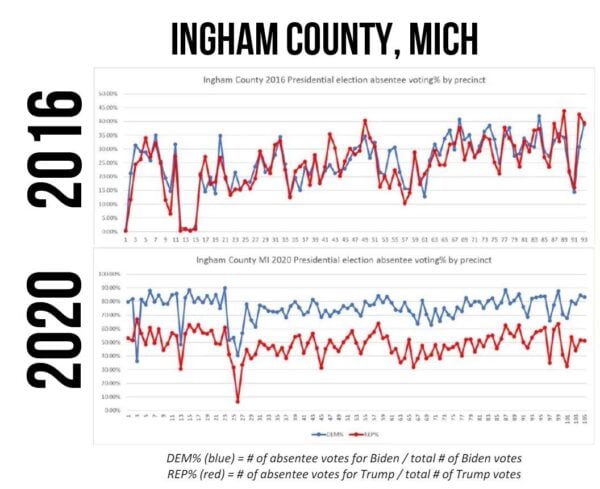
Study Shows Impossible Anomalies Causing Biden ‘win’ in Michigan — In 5 Seconds Biden Racked Up 140,000


Example graphs:


According to the physicist who did these studies (more at link):

In almost every Michigan precinct, Biden had exact 50-55% higher absentee totals than TrumpIn 5 seconds, Biden’s total votes in Michigan went up 140,000 votes. In 9 problem Michigan Counties, the absentee votes between Trump and Biden are so similar that the study’s author says they are clear indications of vote machine manipulation.

“Statistically impossible.”

“The odds here, of all of this, are like winning the Powerball 65 times in a row.”

Tell that to the Trump Threesome:


UPDATE 2: The Michigan AG is blocking the results of the forensic audit of the Antrim County Dominion machines. What does that tell you. SCOTUS coulda heard evidence on that. Ho hum.

UPDATE 3: The SCOTUS as a constitutional institution--and therefore the judiciary as a co-equal branch of government--has delegitimized itself. I don't think that's retrievable. From here on out, US politics will be changed and the rule of law will be sidelined except for a bit of lip service. It's power that will be the currency of the land.

CORRECTION: aNanyMouse states that Rudy Giuliani explained the action of the SCOTUS. Andy S.'s explanation (comment below) is mistaken, and I think a close reading shows that. What the SCOTUS did was claim that in their discretion they were denying leave for Texas to file the complaint. Alito and Thomas stated that the SCOTUS has no such discretion in cases of original jurisdiction and should have granted leave for Texas to file the complaint. Obviously that would have opened the door for submission of evidence, and as to would have been the result of that Alito and Thomas could not speak.

I apologize to readers for jumping to the wrong conclusion.


Thursday, December 10, 2020

VERY BRIEFLY NOTED: Ted Cruz Says Yes

Senator Cruz has agreed, at the request of President Trump, to present the Texas case to the SCOTUS. Remember yesterday, when Andy McCarthy thought it was significant that the TX solicitor general didn't sign the TX complaint--the state's solicitor general being the official who would normally argue TX cases before the SCOTUS? The significance of that was never what McCarthy thought, and may well be that this scenario--with Ted Cruz presenting the case--was baked in quite some time ago.

Of course, Cruz is highly qualified to take that role on. It's not just that he's a senator from this hugely important state and has previously sought the presidency. In his previous life he has argued cases before the SCOTUS and has a 5-4 record. His will be a voice that the justices will be familiar with and, certainly from a legal perspective, will respect. He's Establishment of the Bush Tribe--and if you don't believe me, check out not only Ted's own career but that of his wife Heidi.

Add to that the fact that Cruz knows John Roberts well. It was Cruz who recruited Roberts to the Bush legal team before Roberts' elevation to the SCOTUS. Perhaps Cruz, the DC political and legal insider who sits on the Judiciary Committee, will have some insights into Roberts in Roberts' moment of crisis.

Then there's this, from Don Surber: "The Cruz 2024 campaign is off to a good start."


Wednesday, December 9, 2020

Briefly Noted: Roberts' Folly

John Roberts, by foolishly allowing--on a 4-4 decision--the Pennsylvania Supreme Court to unconstitutionally rewrite Pennsylvania's election laws, has managed to maneuver the SCOTUS into a damned if you do, damned if you don't position. Half the states, with Texas at their head, are now calling the SCOTUS to account. No matter what the SCOTUS does at this point one half of the country will be angry and will claim they were cheated. While not everyone would have been happy had the SCOTUS dealt with the illegalities before the election, the Court would at least have had a better chance of convincing the nation that they were acting on constitutional principle. Realistically speaking, any such hope is probably gone. And this state of affairs is largely Roberts' doing.

The SCOTUS will take another hit to its prestige, almost no matter what. And, since the other justices are surely angrily aware of what Roberts has done, any illusions Roberts may have had of being a Chief Justice who could be a leader have probably already gone down the drain. He has marginalized himself while also weakening the Court.


Tuesday, December 8, 2020

UPDATED: SCOTUS Rejects Kelly's PA Suit Without Comment

Shipwreckedcrew has a good article commenting on how inadequate the PA response was: Pennsylvania's Response Ordered by Justice Alito Reflects Fear of the Defendants About What Might Be Coming. The article was written, of course, before the SCOTUS dropped that particular ball.

Here's how silly he finds the legal arguments, in a nutshell:


The idea that the Supreme Court should shrink from making difficult choices in reaching a decision in a case before it due to the claim by Pennsylvania that no court has ever done this before is moronic.  Yes, it’s never been done before.

Also yes — no State has ever conducted an election in a manner that violated the State’s own Constitution.


OTOH, he closes the article this way--and it reflects what probably happened:


The one issue raised by the Response which I think might resonate with the Court is that any decision which inserts the Court into the determination of Pennsylvania’s Electors runs contrary to “separation of powers” principles which place the responsibility for resolving disputes over the validity of named “Electors” with Congress. ...

This raises the point that I made in my article yesterday — how is the Court prepared to respond if it were to grant the injunction against the Pennsylvania state defendants, and on January 6, 2021, the Joint Session of Congress nevertheless counts the slate of Electors already certified and sent by the Pennsylvania Governor for Joe Biden?

There is no functional method I can envision where the Court would attempt to place itself deeper in this controversy between January 6 and January 21 if the Congress was to certify the vote of the Electoral College which included 20 Electoral votes from Pennsylvania in favor of Joe Biden. ... I think there is no question that the Democrats, in their overriding desire to be rid of Donald Trump and deny him a second term, will disregard the damage they would do to the Court by ignoring any Order and moving forward. ...


Damage to the SCOTUS? How about damage to the Constitution and the nation?

What this means is that the SCOTUS will be de facto acquiescing to a federal election system that it tacitly acknowledges is broken beyond repair. In other words, to a broken US Constitution.

That is, unless the SCOTUS tries to address this mess through the other cases.

UPDATE: Commenter aNanyMouse quotes SWC--after the news came out--saying:


"if the Court was truly seeking to “wash its hands” of all election controversies involving Pennsylvania, it could have said so today, in statements accompanying this Order. By playing “coy” in giving no reason today, it did nothing to “tip its hand” about the sentiment inside the Court, on the actions of the Pennsylvania Supreme Court and state officials, across a host of issues. 


That's a fair take, it seems to me. It also tells the many commenters who are asking, What does it MEAN? about all that we can say: They don't want to tip their hand. Most of the views expressed in the comments remain possible. It does seem that if the SCOTUS had really intended to "wash their hands" of all the election controversies, not only COULD they have said so, but really in fairness to all concerned parties--which would embrace the entire country--they SHOULD have said so.

My view, as already expressed, is that this is not simply a legal matter--it's a political matter in the big picture meaning of the word, involving all three Constitutional branches of government, co-equal and intended to balance one another. I believe that at least five of the justices truly want to reach a balanced resolution and are appalled at what they know has transpired. They know that our constitutional order is up for grabs. But as a constiutional institution seeking to preserve that constitutional order they can't simply go on gut convictions--as commenter EZ indicated, they're searching for the right way to come to grips with this crisis that is in harmony with the order they want to preserve. Is the Texas case the way forward? Maybe. Is there something else that we don't know about? Maybe.

It's not a satisfactory position for us to be in.


Texas Sues: Looks Like A Game Changer

First--I'll be away from the blog for about three hours, starting in one hour. Comments will be enabled upon return.

The Texas lawsuit looks like it could be a real game changer--legally, of course, but perhaps most importantly, politically. We've always spoken of the lawlessness of the Dems in the conduct of elections, but when things reach this point the issue is political, in the big picture sense of the word: It's really about our constitutional order, and that's why Texas is alleging violations of the US Constitution--the compact and the glue that holds this country together.

First and foremost, this lawsuit brings all four of the named states--as well as Texas--before the SCOTUS. Immediately. My reading of this is that the elections in these states cannot be certified or, alternatively, any certification should be held to be without effect (a bit more below).

Breitbart has a good account of the lawsuit, which is very straightforward in its essentials. The lawsuit alleges that four states (PA, MI, GA, WI) and certain counties within those states violated the US Constitution in two respects in their conduct of the presidential election.


First, they violated the Electors Clause of Article II of the Constitution when executive or judicial officials in the states changed the rules of the election without going through the state legislatures. The Electors Clause requires that each State “shall appoint” its presidential electors “in such Manner as the Legislature thereof may direct.”


Here's the text of Article II (in relevant part):


Article II, Section 1: Elections 

The executive Power shall be vested in a President of the United States of America.

He shall hold his Office during the Term of four Years, and, together with the Vice President, chosen for the same Term, be elected, as follows:

Each State shall appoint, in such Manner as the Legislature thereof may direct, a Number of Electors, equal to the whole Number of Senators and Representatives to which the State may be entitled in the Congress: but no Senator or Representative, or Person holding an Office of Trust or Profit under the United States, shall be appointed an Elector.

...


This is exactly the provision that the feckless John Roberts--in the 4-4 pre-Justice Amy SCOTUS--tried to sidestep, by saying that what the PA Supreme Court did with regard to federal elections held in PA was no concern of the SCOTUS. Texas is telling Roberts and every other justice on the SCOTUS that what the corrupt political machines within portions of these four states have done to the Constitution IS TEXAS' CONCERN. And that means that it better become the SCOTUS' concern, too, because Texas doesn't stand alone in this.

If states are allowed to alter the rules set by the US Constitution, then the US Constitution has become a dead letter. That's the subtext to this allegation, and the SCOTUS cannot be unaware of that.