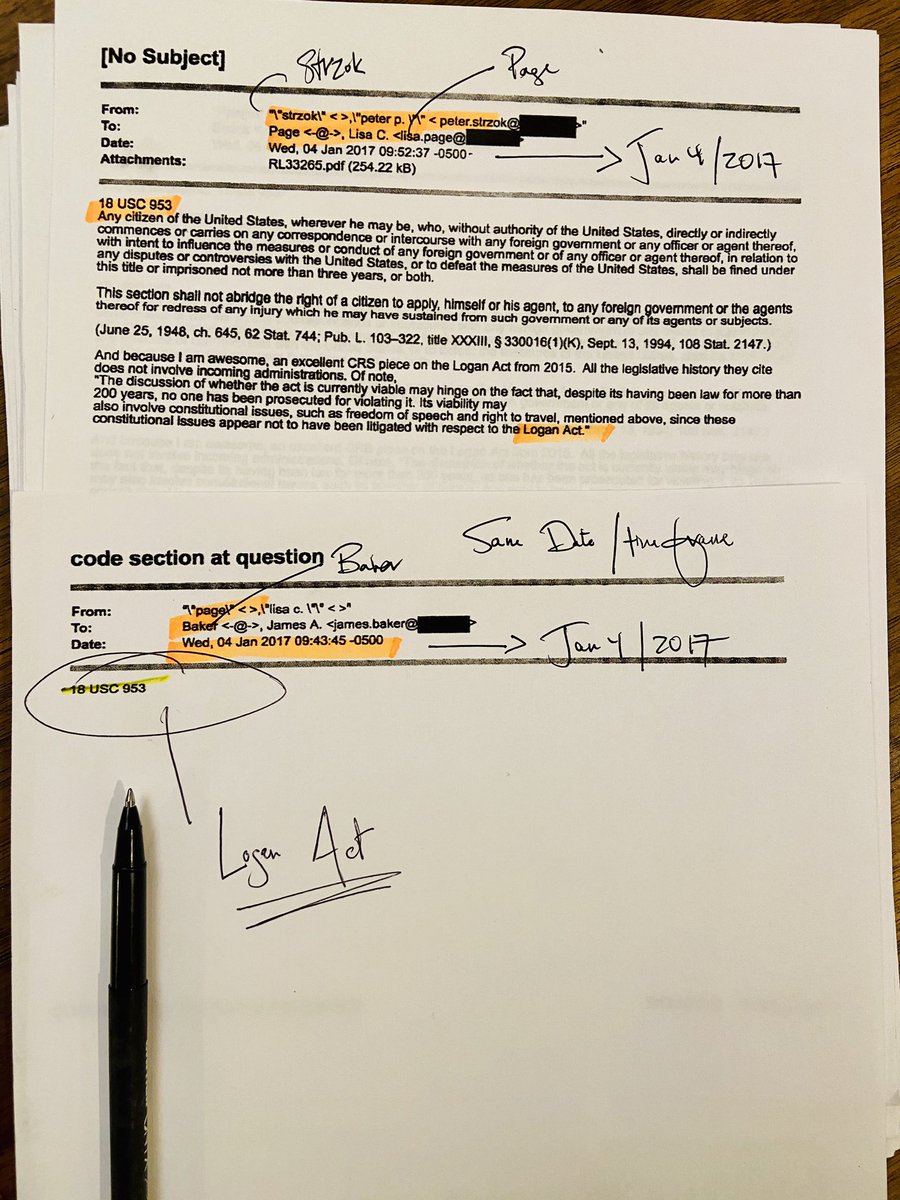
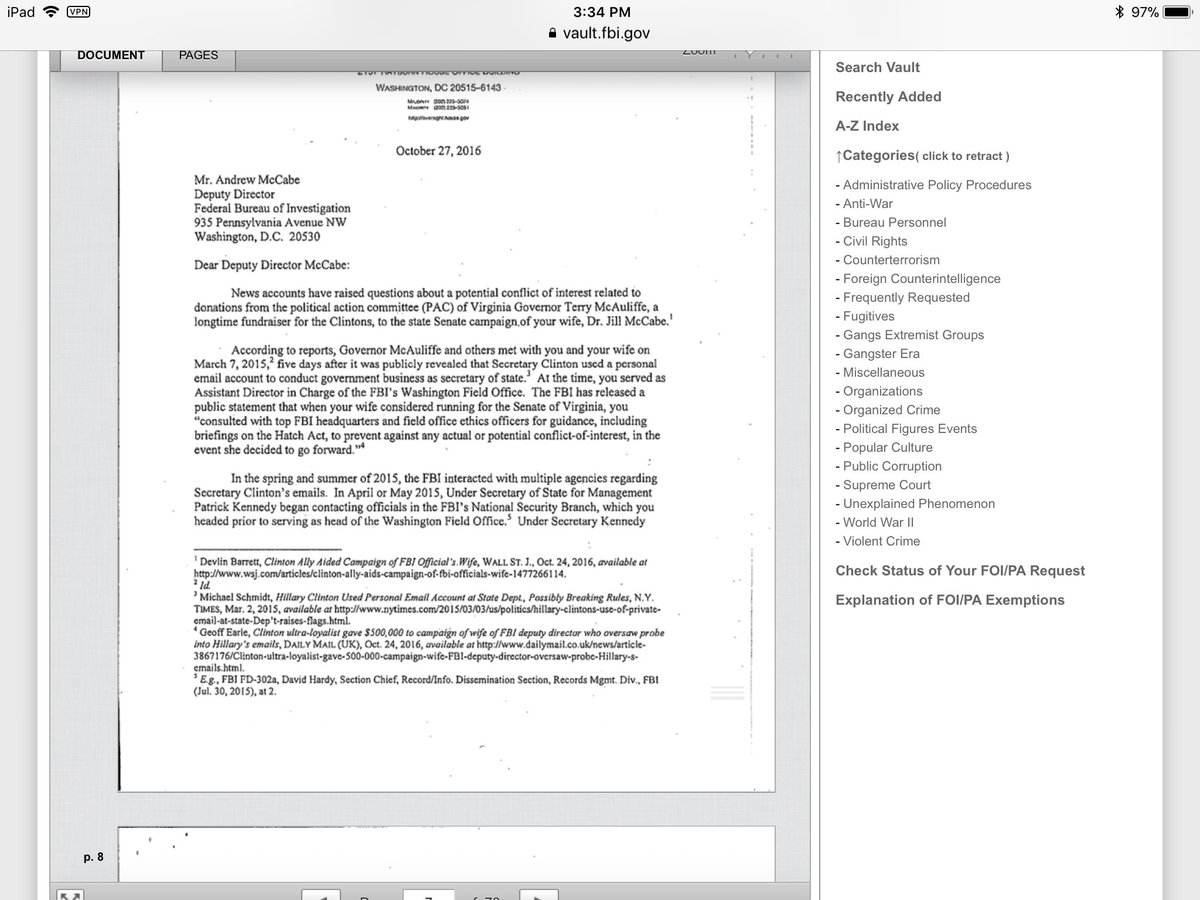
Well, if we're talking about Jeffrey Toobin--legal fabulist for CNN--and his new book, "TRUE CRIMES AND MISDEMEANORS: The Investigation of Donald Trump," then I think we're talking fiction on several levels.
I really hadda laugh last night when I read an article at The Hill--
FBI officials hid copies of Russia probe documents fearing Trump interference: book--that recounted an excerpt from Toobin's novel at
CNN. My first thought was, Whoa! Theft and/or Destruction of Government Property in furtherance of a conspiracy to defraud the government of honest services! Or, in the alternative, in furtherance of a conspiracy to defraud certain named persons of their constitutional rights. In plain sight--I couldn't believe McCabe could be publicly admitting to that. Here's what The HIll said:
Former FBI Deputy Director Andrew McCabe and other top officials reportedly took steps to preserve memos authored by former Director James Comey and other key documents related to the Russia investigation over worries that President Trump would interfere in the probe, CNN reported Thursday.
In the days following Comey's ouster in 2017, McCabe reportedly thought that President Trump's decision to remove the FBI director was problematic and, as the then-acting director of the agency, instructed his team to open a criminal case, according to an adapted excerpt from CNN legal analyst Jeffery Toobin's book, "True Crimes and Misdemeanors: The Investigation of Donald Trump."
...
McCabe, fearing that he would not last at the agency given the tumultuousness of the moment, then acted to preserve Comey's memos detailing his conversations with Trump as well as other related documents on the FBI's internal system, thus ensuring that they could not be destroyed, according to CNN.
Other officials sent documents including the memos to remote locations throughout the FBI, according to CNN, with the goal of preserving them to be shared at a later date.
Did you catch what was going on? Here's the key phrase: "McCabe ... acted to preserve Comey's memos ...
on the FBI's internal system." And just to be sure we have that right, here's Toobin:
McCabe couldn't be sure how long he'd last as director, so he wanted to lock down as much evidence as possible. Most important, he told the investigating agents to place Comey's memos in SENTINEL, the FBI's case management software. McCabe knew that once documents were inside the system, they were virtually impossible to remove. With Comey's memos in the system, the investigators were certain to have access to them -- even if McCabe himself would eventually be gone.
...
Would Trump dismiss more people? Would he shut down the investigation of his campaign's ties to Russia? Would the President demand that the Bureau cease its investigation of Michael Flynn, Trump's onetime national security adviser?
Wait--does that mean that
Comey's memos had previously NOT been in SENTINEL? Yes, it does, but, Excuse me!
ALL official records must be preserved on the official file system. No exceptions allowed. Believe me--if there's a reason to restrict access to particular investigations within the FBI file system, there are well established, tried and tested, methods for doing so. That's absolutely basic for any investigative agency. It's no more than the application of the basic need-to-know principle that governs all investigative activity.
All Toobin is actually doing is providing us with McCabe's self serving account of how the Comey memos finally--months after some were written--found their way into the FBI's file system
where they belonged in the first place. In other words, this is a backhand admission that Comey, McCabe, and presumably others were
maintaining a private file system apart from the FBI's official file system. The facts of what happened, as opposed to Toobin's fictional account, run like this:
After Comey's firing McCabe and other top conspirators--undoubtedly including McCabe but also, in all likelihood, James Baker and possibly a few others--afraid that the nature and extent of their conspiracy would become widely known throughout the FBI and DoJ and thus leakable, as also the fact that they had been maintaining a private file system, i.e., conducting a private investigation--scrambled to get the private file system uploaded into the official file system.
The idea that entering Comey's memos into the FBI file system was a security measure rather than an after the fact CYA measure doesn't come remotely close to passing the laugh test.